



Satellite Internet Stocks in India





Key takeaways
- No operator is currently providing commercial satellite internet services in India. Starlink, Eutelsat OneWeb and the Jio-SES hold licences but await security clearances and spectrum.
- The Digital Communications Commission approved a spectrum charge of 5% of adjusted gross revenue (AGR) in September 2026. However, it still needs Union Cabinet approval.
- On 8 October 2026, the government said all three licensees are at a similar stage, after Elon Musk alleged that Starlink was being blocked.
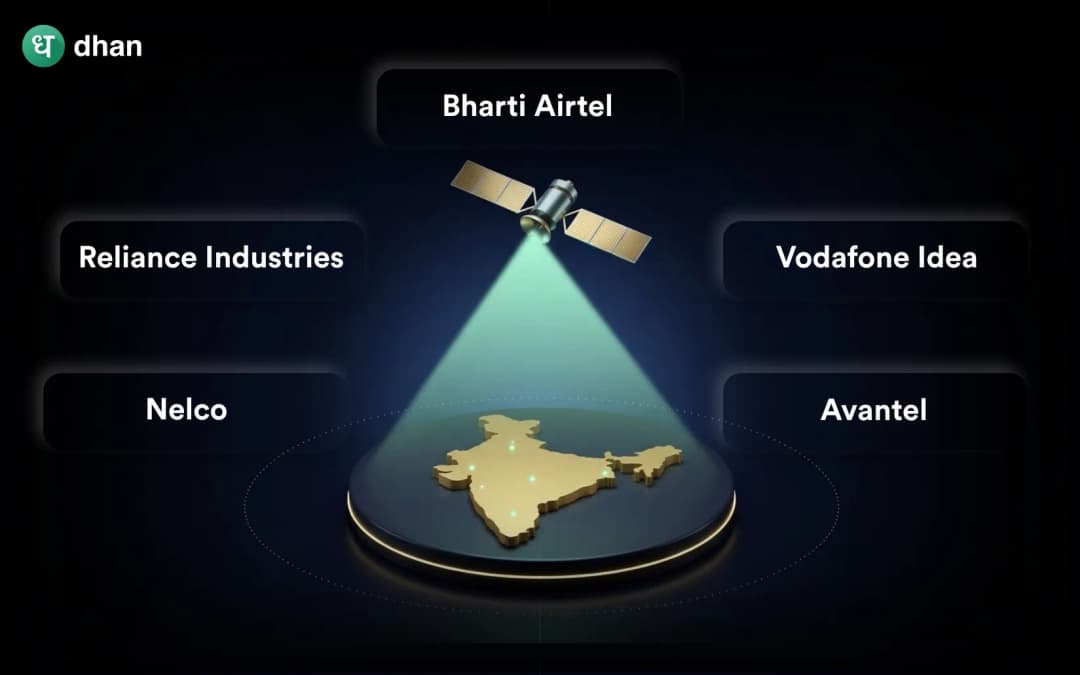
- Bharti Airtel, Reliance Industries, Nelco, Vodafone Idea, and Avantel offer investors exposure to the satellite internet segment in India.
The debate has highlighted a larger opportunity: satellite broadband could bring internet access to parts of India where fibre and mobile networks remain difficult or uneconomical to deploy.
However, no operator has yet launched commercial satellite-internet services in India. Starlink, Eutelsat OneWeb and the Jio-SES have secured the required licences, but they are still awaiting spectrum allocation and security clearances before services can begin.
This has put the spotlight on listed companies that could benefit from the development of India’s satellite-communication ecosystem. In this blog, we will explore the stocks that offer exposure to the satellite-internet segment in India.
Where does satellite internet stand in India?
India has opted for administrative allocation of satcom spectrum instead of auctions. In May 2025, TRAI had recommended that the operators pay 4% of their adjusted gross revenue (AGR), with a minimum of ₹3,500 per MHz per year. It also said operators providing services in urban areas should pay an extra ₹500 per subscriber each year.
In September 2026, the Digital Communications Commission, the highest decision-making body in the Department of Telecommunications (DoT), approved most of those recommendations. It proposed a spectrum usage charge of 5% of AGR and refused to accept the per-subscriber levy and rural subsidy. But this 5% fee is yet to be approved by the Union Cabinet.
Three operators hold licences: Starlink, Eutelsat OneWeb, and Jio-SES, but none of them has initiated any commercial satellite internet services in India due to lack of commercial spectrum allocation and security clearance from the government.
Which listed companies have exposure to satellite internet?
India has no listed pure-play satellite internet operator, so exposure comes through telecom and satcom service companies. Some of them are:
Bharti Airtel Ltd.
Airtel offers satellite internet exposure as a distributor and connectivity provider. On 11 March 2025, it signed a deal with SpaceX to provide its customers with Starlink, subject to SpaceX receiving its own authorisations.
In 2022, Airtel took about a 33% stake in Hughes Communications India, a VSAT satellite joint venture which offers flexible and scalable satellite and hybrid enterprise networking solutions. Additionally, Bharti Space, a promoter-group company and not Airtel itself, owns 17.88% of Eutelsat, OneWeb's parent, which holds GMPCS licenses.
Reliance Industries Ltd.
Reliance offers exposure to satellite internet through Jio, which is building its own satellite broadband business. Jio-SES, Jio’s venture with SES, holds one of the three licences. Additionally, in March 2025, Jio Platforms signed an agreement with SpaceX to sell Starlink broadband internet services to its consumers in India.
At its June 2026 AGM, Akash Ambani said that Jio is evaluating development of its own sovereign low earth orbit satellite constellation, and plans to lease capacity from global operators in the meantime. In October, it proposed deploying 1,600 Low-Earth Orbit satellites and building 23 ground stations across India.
Nelco Ltd.
Nelco, a Tata Group company, offers exposure to satellite internet as a service provider by offering VSAT-based connectivity to enterprises. It signed an agreement with Eutelsat on 11 August 2025, under which it will also provide OneWeb's LEO services in India upon their launch.
In a January 2026 filing, it stated that it had voluntarily withdrawn its own GMPCS application and now holds authorisations to resell satellite services. In August 2026, it announced that it would invest $20 million (approx ₹191 crore) in Lunar Holdco Inc. to target enterprise satellite connectivity in India and South Asia.
Vodafone Idea Ltd.
Vodafone Idea (Vi) offers exposure through direct-to-device (D2D) service, in which phones connect directly to satellites. On 18 June 2025, it announced a partnership with AST SpaceMobile under which AST SpaceMobile will build the constellation while Vi provides spectrum, network integration and market access.
This model aims to eliminate rural network dead zones without extensive ground tower infrastructure, but requires regulatory guidelines to allow terrestrial spectrum sharing for satellite links.
Avantel Ltd.
Avantel provides hardware support for the satellite communication sector. The company specialises in designing and manufacturing customised satcom equipment, radar systems, and ground-station network hardware for both LEO and GEO satellite systems at its Vijayawada facility.
It also has a Ku-band VSAT licence. It secured a ₹117.88 crore contract with DRDO for a satellite ground-segment hub on 31 August 2026 and a ₹177.35 crore contract with Zetwerk for satcom equipment in September.
Final thoughts
Satellite internet in India is on the verge of becoming a reality. Though key foundational steps have been taken, such as the Digital Communications Commission's (DCC) proposal of a 5% spectrum usage charge for AGR and license clearances for major players, the key players are still awaiting Union Cabinet approval, a final security assessment, and actual spectrum assignment.
For stock market investors, satellite internet represents a multi-year thematic opportunity rather than an immediate revenue driver. Because there are no pure-play satellite operators listed on Indian exchanges, exposure can be obtained through telecom conglomerates, specialised service & technology players and hardware & infrastructure enablers.