



Best US ETFs for Indian Investors in 2027






Key takeaways:
- Resident Indians can invest in US-listed ETFs through the RBI's Liberalised Remittance Scheme(LRS), which allows them to remit up to $250,000 per financial year.
- For overseas investment in FY 2026-27, tax collected at source (TCS) is zero on the first ₹10 lakh remitted and 20% on amounts above that. The tax can be adjusted against income tax.
- Gains on foreign-listed ETFs held for more than 24 months are taxed at 12.5%, and gains for investments held for less than 24 months are taxed at investors’ slab rate.
- The US withholds 25% tax on dividends paid to Indian residents, and India taxes this dividend income as income from other sources at the investor's slab rate.
- Indian investors can claim the 25% tax withheld in the US as a credit while filing their ITR.
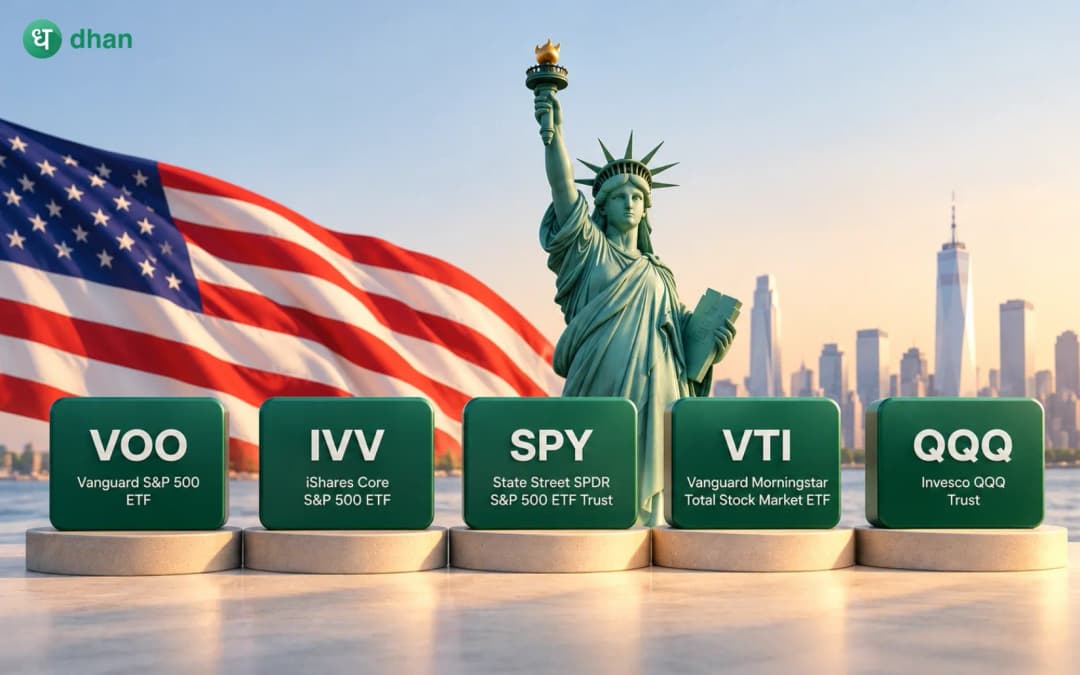
- VOO, IVV and SPY track the same S&P 500 Index, while VTI offers broader US market exposure and QQQ provides a technology-heavy Nasdaq-100 allocation.
Savvy investors often diversify their portfolio across various geographies. Investing all their capital into a single economy makes their portfolio vulnerable to local regulatory shifts, inflation spikes, and currency depreciation.
For Indian investors seeking to build a robust, globally diversified portfolio, the US stock market offers an attractive opportunity. It lets Indian investors invest in some of the world’s largest companies through a single listed security, gaining diversified exposure. In this blog, we will explore a few US ETFs that Indian investors can consider.
How can Indian investors buy US ETFs?
The RBI's Liberalised Remittance Scheme (LRS) allows the remittance of up to $250,000 per financial year for permitted current or capital account transactions, including investments abroad, by resident individuals. Banks collect tax at source (TCS) on these remittances.
For FY 2026-27, TCS on investment remittances is zero up to ₹10 lakh a year and 20% above it. Budget 2026 reduced the TCS only for education, medical and tour-package remittances. This deducted TCS can be adjusted against the investor's final income tax liability.
How are US ETFs taxed for Indian investors?
Gains on US-listed ETFs held for more than 24 months qualify for long-term taxation and are taxed at 12.5%. Gains on holdings of 24 months or less are added to investors' income and taxed at their slab rates.
Dividends received from US ETF investments are taxable in India at investors' applicable slab rates, and the US withholds 25% at source on dividends paid to Indian residents under the India-US treaty. However, Indian investors can claim the 25% tax withheld in the US as a credit by filing Form 67.
Which US ETFs can Indian investors consider in 2027?
Here are the top 5 US ETFs that Indian investors can consider:
Note: NAV is in US dollars as of 10 October 2026.
Vanguard S&P 500 ETF (VOO)
VOO offers exposure to 500 leading US companies through the S&P 500 Index. It charges an expense ratio of 0.03%. NVIDIA, Apple and Alphabet are its largest holdings. The top ten made up 37.9% of net assets, and information technology was 38.0% of its portfolio. Vanguard reported $1.03 trillion in ETF net assets as of September 2026.
iShares Core S&P 500 ETF (IVV)
IVV offers exposure to large US companies through the S&P 500 Index. It charges an expense ratio of 0.03% and held 504 positions as of October 2026, while information technology made up 39.61% of the portfolio. Net assets were about $896 billion as of October 2026, and the fund was launched in May 2000. NVIDIA, Apple, and Microsoft Corporation are its largest holdings.
State Street SPDR S&P 500 ETF Trust (SPY)
SPY offers exposure to the S&P 500 Index through a unit investment trust. Launched on 22 January 1993, it was the first ETF listed in the US. Its gross expense ratio is 0.0945%, compared with 0.03% for VOO and IVV, and it held 504 holdings as of October 2026. NVIDIA, Apple and Microsoft are its largest holdings, and the information technology sector holds about 39.70% of the portfolio. It has assets under management (AUM) of about $817 billion.
Vanguard Morningstar Total Stock Market ETF (VTI)
VTI offers exposure to nearly the whole US stock market, including large-, mid- and small-cap companies, through the Morningstar US Total Market Index. It charges an expense ratio of 0.03% and has 33.4% of its assets in its top ten holdings. On 29 July 2026, Vanguard Total Stock Market ETF was renamed to Vanguard Morningstar Total Stock Market ETF and its index was changed from the CRSP US Total Market Index to Morningstar US Total Market Index. However, the ticker and index construction remained unchanged.
Invesco QQQ Trust (QQQ)
QQQ offers exposure to the Nasdaq-100 Index, which covers the 100 largest non-financial companies listed on Nasdaq. Since 19 December 2025, it has been an open-end fund instead of a unit investment trust, and its expense ratio fell from 0.20% to 0.18%. As of March 2026, it holds 102 portfolio holdings and $371 billion in net assets. NVIDIA, Apple and Microsoft were the largest holdings, and information technology captured about 50% of the portfolio as of October 2026.
Final thoughts
VOO, IVV and SPY track the S&P 500 Index and hold the same stocks. They differ primarily in cost and structure: SPY is a unit investment trust with a gross expense ratio of 0.0945%, against 0.03% for the other two. VTI offers exposure to mid- and small-cap companies, and QQQ offers exposure to the Nasdaq-100.
Before investing, Indian investors should compare expense ratios, liquidity and underlying holdings. They should also take into account currency risk, US dividend withholding tax, Indian tax regulations and their risk tolerance. Additionally, ETF returns are market-linked, and past performance is not indicative of future performance.