



Types of Gaps in Trading




Key takeaways
- A trading gap occurs when an asset opens significantly below or above its previous closing price, leaving a visible price gap on the chart.
- The four commonly discussed types are common gaps, breakaway gaps, runaway gaps, and exhaustion gaps, and each can appear at a different stage of a price move.
- A gap should not be interpreted on its own. Volume, trend, support and resistance, and subsequent price action can help traders determine whether the gap is likely to continue or reverse.
Markets do not always move smoothly from one price to another. Sometimes, an asset closes at one price and opens considerably higher or lower in the next trading session. The empty area created between these two prices is known as a gap.
For instance, let us say that a stock closes at ₹500 on a Monday, but opens at ₹520 on a Tuesday. If there were no trades between ₹500 and ₹520 during the transition, then you will see a gap on the chart between these two prices.
Gaps can develop because of overnight news, earnings announcements, changes in market sentiment, economic events, or a sudden shift in demand and supply. However, not every gap has the same meaning. A gap appearing during a sideways market may tell a very different story from one that occurs after a long-established trend.
This is why traders commonly classify gaps into four types: common, breakaway, runaway, and exhaustion gaps.
What is a Gap in Trading?
A gap is a discontinuity between the closing price of one trading period and the opening price of the next. On a candlestick chart, it appears as an empty space between the previous candle's price range and the next candle's range.
Gaps can occur in either direction. A gap up happens when the market opens above the previous session's high or, more broadly, significantly above its previous close. A gap down occurs when the market opens below the previous session's low or significantly below its previous close.
The size and location of the gap matter. More importantly, traders need to examine what was happening before the gap and what the price does afterward.
The 4 types of Gaps in Trading
The four types of trading gaps are explained in the following sections:
Common Gap
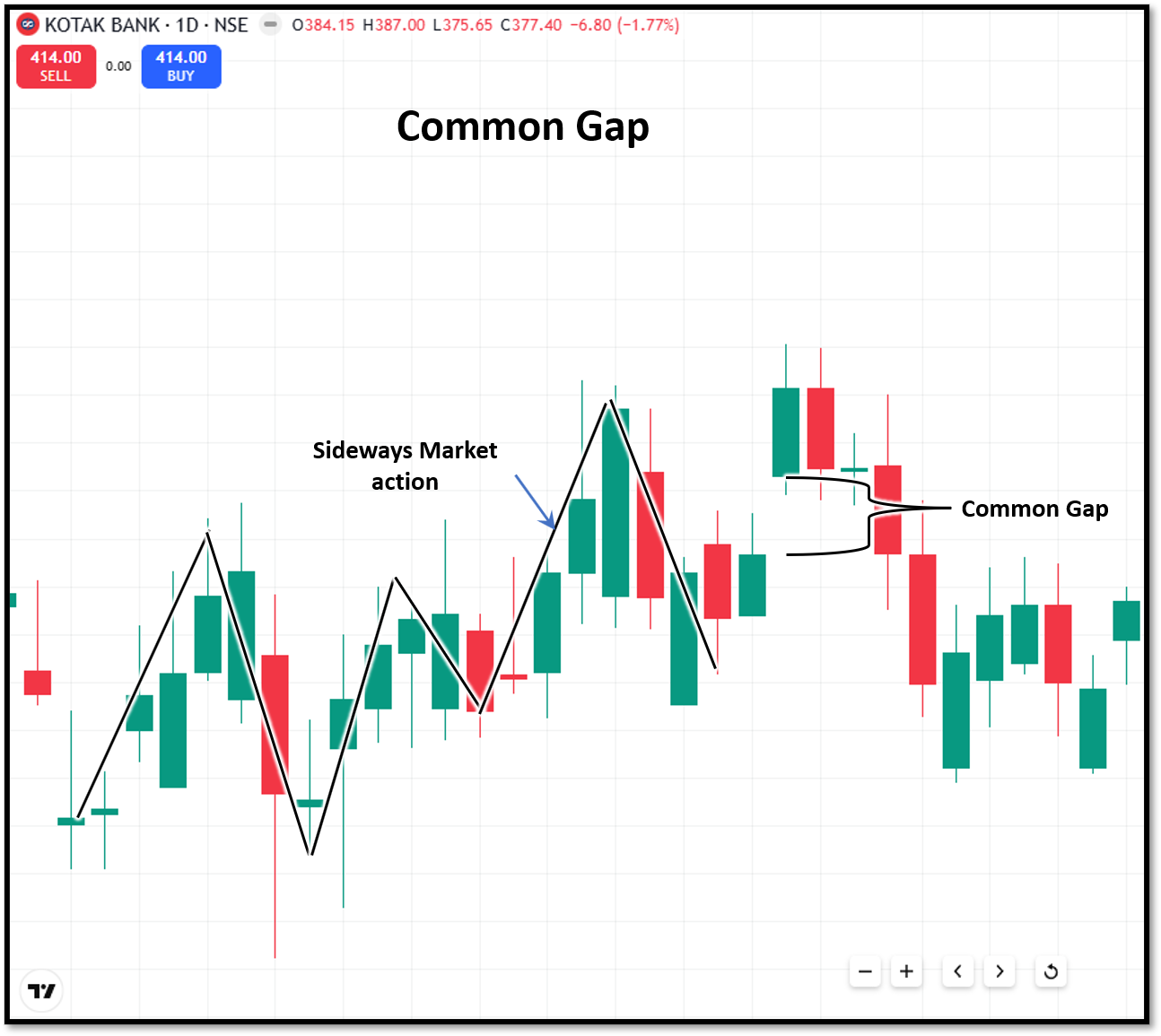
A common gap usually appears within a sideways or relatively stable trading range. It is often caused by temporary changes in buying and selling pressure rather than a major change in the underlying trend.
These gaps are generally smaller and may occur without a significant breakout from an established price structure. Because there is no major trend change associated with them, common gaps are often less useful as standalone directional signals.
A common gap may also get filled relatively quickly. A gap fill occurs when the price subsequently moves back through the area created by the gap.
Breakaway Gap
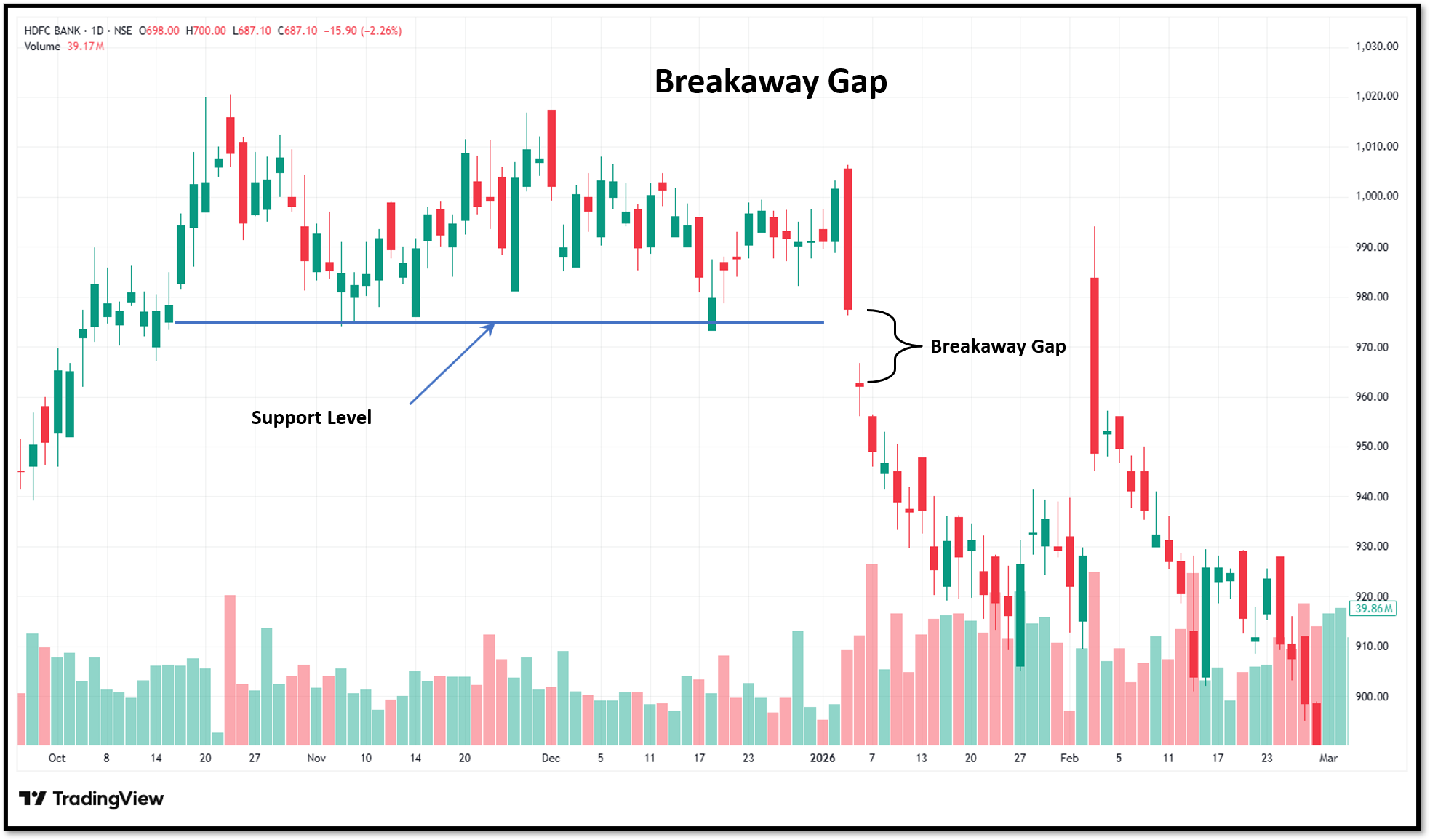
A breakaway gap occurs when price gaps out of an established trading range, consolidation area, or chart pattern. Unlike a common gap, a breakaway gap can mark the beginning of a new trend.
Suppose a stock is facing resistance to move above ₹1,000. After several weeks of consolidation below this resistance, the stock opens at ₹1,035 following strong buying interest. If it remains above the previous resistance and continues higher, the gap may be interpreted as a breakaway gap.
The key feature is not simply the size of the gap. Its location within the price structure is important. The gap should represent a meaningful move away from an area where price had previously been contained.
A breakout accompanied by noticeably stronger trading activity can suggest greater participation behind the move, although volume alone does not guarantee that the breakout will succeed.
Runaway Gap
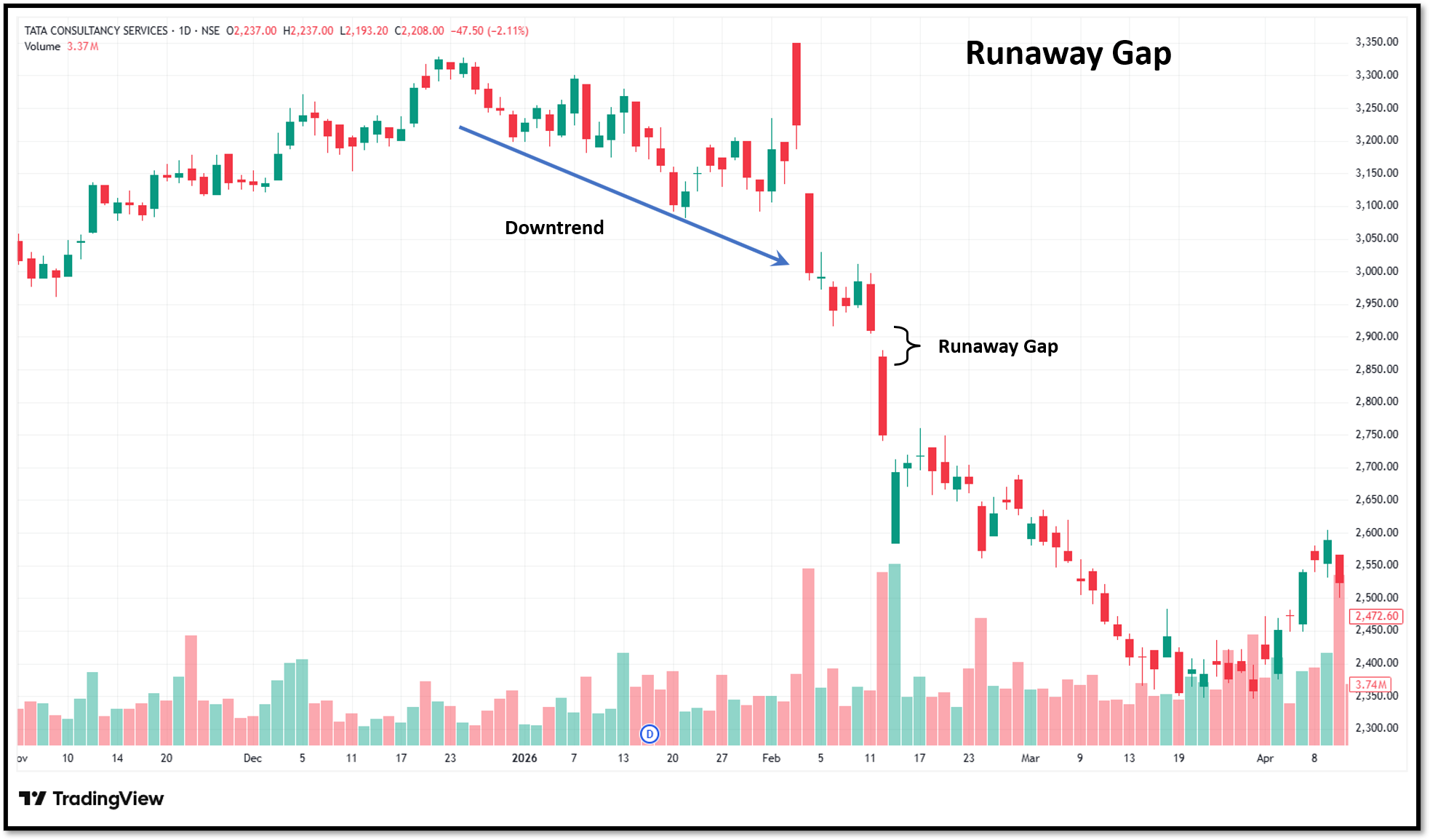
A runaway gap, also called a continuation gap, usually appears in the middle of an established trend. It suggests that the existing directional move still has considerable participation behind it.
In an uptrend, a runaway gap occurs when price opens significantly higher and continues moving upward. In a downtrend, the equivalent move occurs to the downside.
The important distinction is that the trend already exists before the gap appears. The gap does not necessarily start the trend; instead, it can indicate that the trend is gaining momentum or continuing after a temporary pause.
Exhaustion Gap
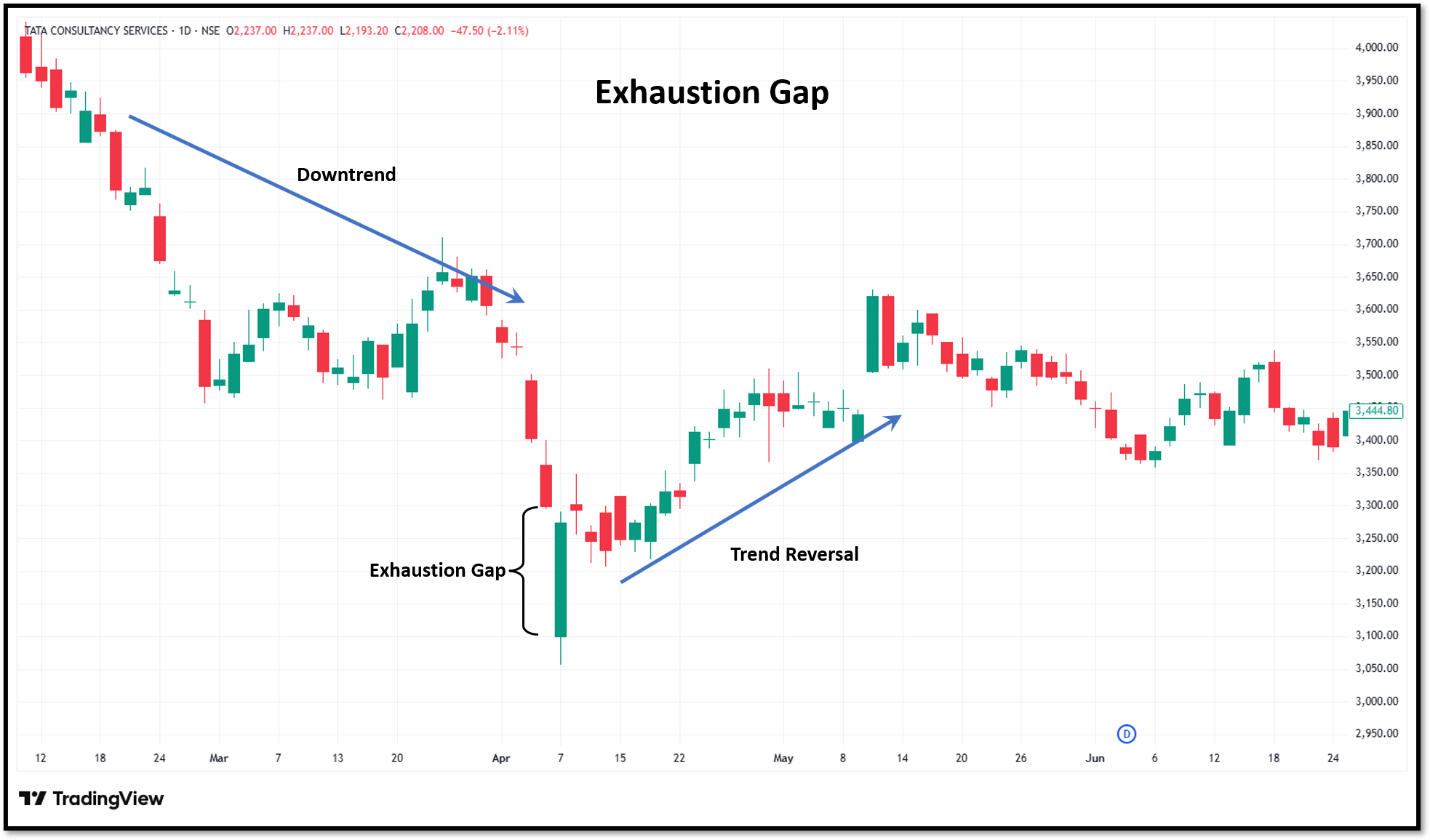
An exhaustion gap generally appears towards the end of a powerful trend. It can happen when excited buying or selling causes price to move sharply in the direction of the trend, but the move fails to attract enough new participants to continue.
This makes exhaustion gaps particularly important because they can occur close to potential reversals.
An exhaustion gap can initially look similar to a runaway gap. The difference often becomes clearer through subsequent price action. If the market fails to continue in the direction of the gap and then reverses sharply, the gap may have represented exhaustion rather than continuation.
How to differentiate the four types of gaps
The easiest way to classify a gap is to examine where it occurs in relation to the existing trend or trading range.
What should traders check after a gap?
Entering just because a gap appears can lead to wrong decisions; hence, before entering or interpreting the gap, traders should also check the following:
Volume
Volume helps traders understand how much participation accompanied the gap. A significant increase in volume can add context to a breakaway or continuation move, while weak participation may make the move less convincing.
Trend
Before identifying a gap, spot the trend. A gap in an established uptrend means something different from a gap that appears after an extended decline.
Support and resistance
Mark important support and resistance levels before interpreting the gap. A gap that moves price decisively beyond a major resistance level is structurally different from a small gap occurring in the middle of a range.
Price action after the gap
The price behaviour after the opening gap is usually more informative than the gap itself. If the price continues to move in the same direction can support a continuation interpretation, while a quick reversal back into the previous range can weaken the original signal.
A practical approach to analysing gaps
Instead of immediately buying a gap up or selling a gap down, traders can follow a simple sequence.
- Identify the existing market structure. Is price trending, consolidating, or already showing signs of weakness?
- Mark key support and resistance levels. This helps to know if the gap is happening within a range, breaking out of a range or after a prolonged move.
- Look at volume and candles afterwards. So more confidence in a real breakout or continuation can be gained with high volume and ongoing movement, while a quick return into the old range warrants caution.
- Define the trade's risk before entering. A gap can produce rapid price movement, so traders should avoid deciding their stop-loss only after the position has already been opened.
Conclusion
The four major types of trading gaps - common, breakaway, runaway, and exhaustio - provide a useful framework for understanding sudden changes in price.
A common gap generally appears within a trading range. A breakaway gap can signal a move out of established price structure. A runaway gap tends to occur during an existing trend. An exhaustion gap, meanwhile, can appear near the later stages of an extended move and may warn that momentum is weakening.
FAQs
What are the four types of gaps in trading?
The four commonly discussed types are common gaps, breakaway gaps, runaway gaps, and exhaustion gaps.
Which gap usually occurs within a trading range?
A common gap typically occurs within a sideways or consolidating market. It does not necessarily indicate that a new trend is beginning.
How can volume help identify a gap?
Volume provides information about market participation behind the price move. Higher volume can add confirmation to a breakout or continuation.
Can a gap be used as a trading signal by itself?
It is generally better not to rely on the gap alone. The broader trend, support and resistance, volume, and price behaviour after the gap can provide important confirmation.
Why are breakaway gaps important?
Breakaway gaps can show that price has moved decisively away from a previous trading range or important level. This makes them useful for traders studying potential changes in market structure.