



Why do F&O Stocks Enter Ban Period?





Key takeaways
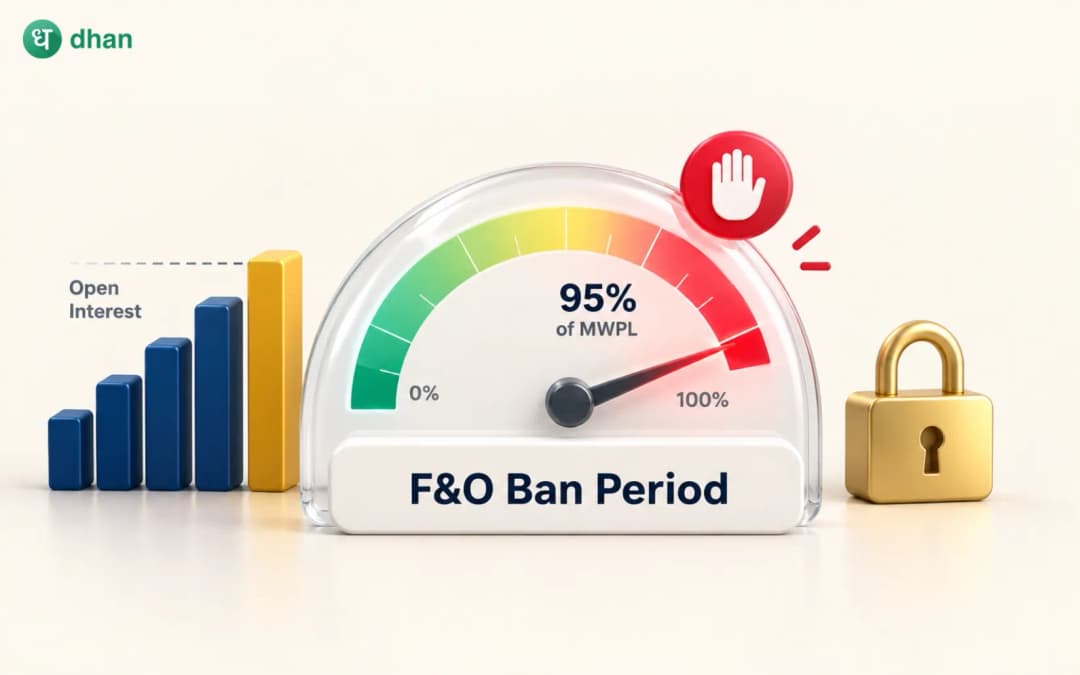
- A Futures and Options (F&O) ban happens when open interest crosses 95% of the Market Wide Position Limit (MWPL). During the ban, traders can only reduce their F&O positions.
- The stock can still be traded in the cash market.
- Normal F&O trading can resume when open interest falls to 80% or below of MWPL.
- An F&O ban is about open positions, not necessarily a problem with the company.
When trading in the futures and options market, traders may sometimes see a stock listed under the F&O ban period. This can be confusing, especially when the stock is still available for normal buying and selling in the cash market.
An F&O ban does not mean that trading in the stock has stopped completely. It is related to the number of open positions in the stock's futures and options contracts.
The main reason a stock enters the ban period is when the total open interest in its F&O contracts reaches a specified level of its market-wide position limit. In simple words, the exchange puts a restriction on creating new positions when too many F&O positions have already been built in a stock.
What is an F&O ban period?
An F&O ban period is a restriction placed on the derivative contracts of a stock when its combined open interest crosses 95% of the Market Wide Position Limit (MWPL). Once this happens, traders cannot increase their positions in that stock's futures and options contracts. They can only trade in a way that reduces their existing positions through offsetting trades.
For example, suppose a trader already has a futures position in a stock that has entered the F&O ban period. The trader can take an opposite position to reduce or close the existing position. But taking a fresh position that increases the overall open position is not allowed during the ban period.
The restriction is mainly there to control the amount of open interest in the derivatives market.
What is the market wide position limit?
To understand the F&O ban period, it is important to first understand MWPL. It is the maximum number of shares that can be represented through open positions in the futures and options contracts of a particular stock. Under the revised framework, the MWPL for a stock’s Futures and Options (F&O) contracts is determined as the lower of:
- 15% of the free-float holding
- 65 times the average daily delivery value (ADDV)
- A minimum floor of 10% of the free-float holding
This limit applies across the market and not just to one trader or one broker. For example, if a stock has a particular MWPL and traders across the market keep building futures and options positions, the combined open interest keeps moving closer to that limit. The limit gives the exchange a way to keep track of how much open interest is building up in a stock's F&O contracts.
When does an F&O stock enter the ban?
According to NSE, the combined open interest in a stock's futures and options contracts is checked across exchanges at the end of each trading day.
If the open interest crosses 95% of the MWPL, the stock enters the ban period from the next trading day. The ban is based on the open positions that remain in the market, and not simply on the number of contracts traded during the day.
For example, suppose a stock has an MWPL of 10 lakh shares. If its open interest reaches 9.5 lakh shares, it has reached 95% of the MWPL and can enter the F&O ban from the next trading day.
During the ban, traders can close or reduce their existing positions, but they cannot take a position that increases their open interest. If the open interest later falls to 8 lakh shares, which is 80% of the MWPL, normal F&O trading can resume, subject to the exchange's rules.
This is why traders need to keep an eye on open interest when a stock is getting close to its MWPL limit.
Trading the stock during an F&O ban
An F&O ban applies to the derivative contracts of the stock. It does not stop the stock from being traded in the cash market. So, if a stock is under an F&O ban, investors can still buy or sell its shares in the cash market. The restriction is on increasing positions in its futures and options contracts.
A stock also does not remain under the ban period forever. The ban is removed when the combined open interest across exchanges falls to 80% or below of the MWPL.
Traders who already have F&O positions do not have to close everything just because the stock enters the ban. They can take trades that reduce or close their existing positions, but they cannot increase them. For example, if a trader is holding a long futures position, selling the position can reduce the open position. If the trader has a short position, buying the contract can help close it.
Why does the exchange put this restriction?
The restriction is mainly used to control the build-up of positions in the derivatives market.
- It limits the amount of open interest that can build up in a stock's F&O contracts.
- It prevents positions from moving beyond the permitted market-wide limit.
- NSE also uses margin and surveillance measures as a stock gets closer to the ban level.
What should traders do when a stock is near the ban?
When a stock is getting close to its MWPL limit, traders can check its latest open interest and ban status.
This is especially important for traders who already have an F&O position. If the stock enters the ban, they will not be able to increase that position.
NSE publishes the list of securities under the F&O ban for the next trading day, along with open-interest information. Checking this information can help traders understand whether a stock is getting close to the limit.
Can a stock enter the Ban Period frequently?
Yes, a stock can enter the F&O ban more than once if its open interest keeps reaching the MWPL limit.
NSE also considers how often a stock remains under the ban when deciding whether it should continue to be available for F&O trading. If a stock remains under the ban for a significant part of the month consistently for three months, it can affect its eligibility in the F&O segment.
This is different from a stock entering the ban for a day or two. The exchange also looks at the longer-term pattern of the stock's open interest.
Conclusion
An F&O ban is linked to the open interest in a stock's futures and options contracts. Once the open interest crosses 95% of the MWPL, traders cannot increase their F&O positions.
For traders, checking the open interest, MWPL, and ban status can help them understand when a stock is getting close to the limit.
FAQs
When does a stock get into an F&O ban period?
A Futures and Options ban period happens when its total open interest across exchanges crosses 95% of its Market Wide Position Limit.
Can I buy or sell a stock when it is in the F&O ban?
Yes. The stock can still be traded in the cash market. The restriction applies to increasing positions in its futures and options contracts.
Can I close my F&O position during the ban period?
Yes. Traders can take trades that reduce or close their existing F&O positions. They cannot increase their open position during the ban.
When is the F&O ban removed?
Normal F&O trading can resume when the combined open interest falls to 80% or below of the Market Wide Position Limit, subject to the exchange's rules.
Does an F&O ban mean the stock is falling?
No. An F&O ban does not by itself indicate that a stock is falling or that there is a problem with the company. It is mainly related to the level of open interest in its F&O contracts.