



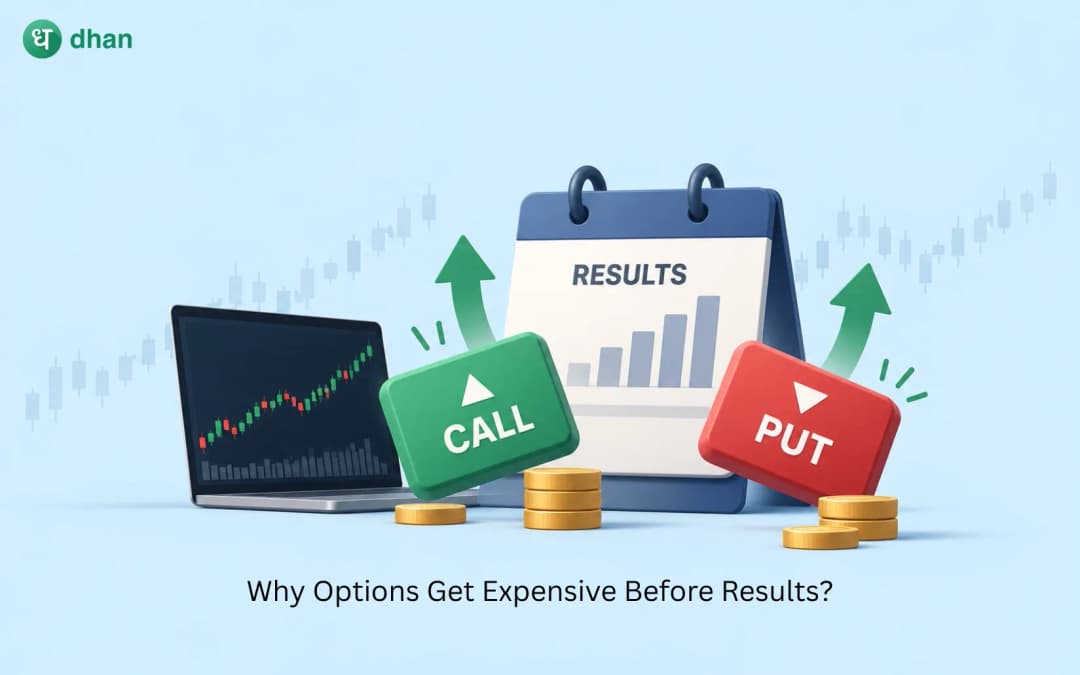
Why do options get expensive before results?





Key takeaways:
- Options get pricey before earnings as traders brace for big swings and drive implied volatility up.
- Buyers push up both calls and puts together, since volatility measures how far the stock might jump, not which direction.
- Once earnings drop, volatility crashes instantly, a drop that can wipe out option profits even if you nail the stock's direction.
- Comparing current volatility against historical norms helps you spot overpriced premiums and determine if pre-earnings trades are worth the risk.
Every quarter, without exception, there is one thing that happens on the options chain. A stock that has been steadily moving up or down for a few weeks suddenly has premiums on its calls and puts that appear extremely overvalued. A trader opens his terminal two days prior to the results and sees prices that do not seem to correlate with the real stock price at all. This is not a bug, and this is not the market acting irrationally. This is a very specific and measurable phenomenon, and knowing about it will help you avoid costly mistakes.
What happens to options before an earnings announcement
Before a company's results, options premiums grow despite the stock price not changing much. For instance, Reliance Industries or HDFC Bank ahead of results will usually observe the increase in premiums not only on options close to the current stock price but also on options far in-the-money and out-of-the-money.
This happens because options pricing does not only depend on the current price of a stock. Options are priced based on where they think the stock may go, and results announcements are the type of event that adds extra uncertainty.
Implied volatility is the true cause of the increase, not the stock price
There is a name for this price inflation phenomenon: implied volatility, or IV. Every options premium consists of several parts, including the current stock price, strike price, time to expiration and expected move of the stock. IV is the last component.
Unlike all other components of options pricing, IV is not calculated directly from the stock chart. IV is derived, or implied, from the options price itself. Whenever traders expect a move (either up or down), they bid up the options prices and thus raise IV. The results season is by far the most predictable cause for that, since nobody knows for sure what the numbers will be.
Here is a good benchmark: if the stock has an IV of 25-30%, usually, during the results season, this value may reach 45% and more in the last week before the results announcement. This is quite a noticeable effect: it can almost double the extrinsic value of the options premium with no changes in the stock price.
Example with numbers
Let us assume the stock trades at ₹1,000 and the at-the-money call option (strike ₹1,000, time to expiration one week) costs ₹16 under normal conditions, IV being 28%. With results approaching and IV growing up to 48%, the premium of the same option may be as high as ₹27 purely because of higher volatility.
This is the pitfall many beginner traders fall into. They see a stock they want to trade, buy a call option ahead of results, anticipating the rally, and although they guess the direction of the price movement correctly, they may still lose money. Why? Because they purchase options with premiums at their maximum value, the inflated premiums crash as soon as the results are out.
IV crush the day after the results announcement
This crash also has a name: IV crush. Once the results are published, the uncertainty which has driven the inflated premium disappears. There is no more 'what if' - everything is known now. IV falls down sharply immediately after the results announcement, sometimes reaching its pre-earnings level of 25-30%.
To use the previous example, if the stock rallies 3% on good results, i.e., goes from ₹1,000 to ₹1,030, one would assume the call option with strike ₹1,000 to appreciate substantially. But if IV drops from 48% to 28% at the same time, the decrease in the extrinsic value may reduce or even cancel the gain made on results. In some cases, traders find themselves with a lower profit or even losses despite guessing the price movement correctly.
This is the most misunderstood aspect of options trading around earnings. It should be repeated again and again: guessing the right direction is not enough. One needs to wait for the price move to be strong enough to compensate for the time decay and the volatility crush acting in opposite directions.
How to detect options being inflated prior to trading
Here are several methods of figuring out whether options are inflated ahead of results release.
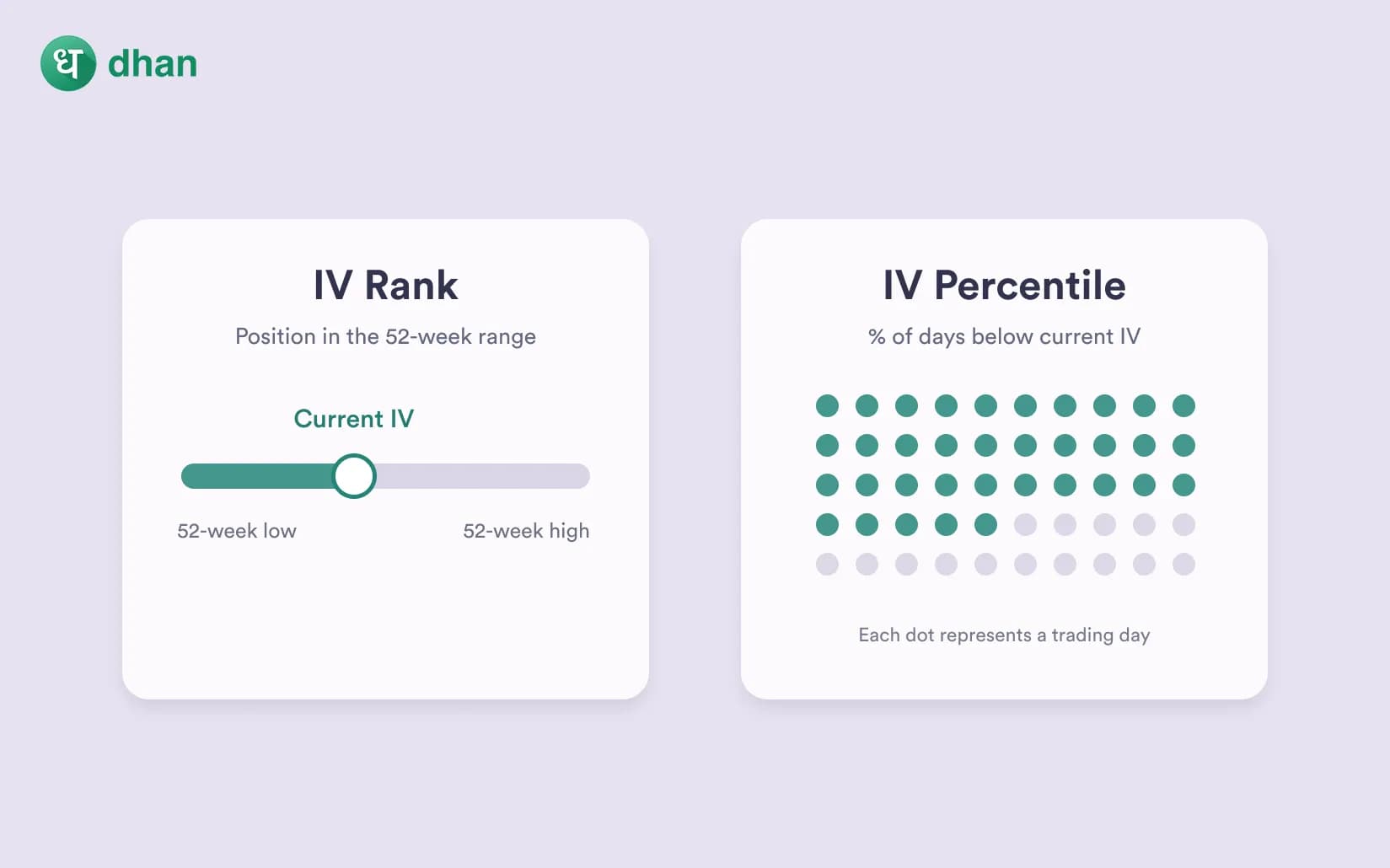
- Check the level of current IV versus the historical average of 30 or 90 days for the stock. An average gap of 15-20 percentage points means that the results premium has already been built into the option prices.
- Inspect the options chain one week and a day prior to results release. If the premiums increase without any real stock price movement, this is IV inflation, not intrinsic value.
- Take a look at the historical IV crush pattern for that particular stock. There are some stocks whose IV tends to fall by 15-25% in a single day after the release of their results. This information is available on any options analytics platform, and Dhan's options chain tool allows you to track the IV percentile along with current premiums, making this comparison considerably faster than calculating it manually.
Strategies accounting for IV crush instead of struggling against it
Instead of buying one call or put and waiting for both its direction and move size to be right, one may try to make money on the IV crush itself by selling options before the results are released. Short straddles and iron condors are specifically designed to earn on IV crush, although they have their downsides, including the risk of the stock making too big a move.
One of the simpler solutions to this problem would be to refrain from buying options solely because of the results if you do not have a good idea of the move size in advance. For those who still want to make directional bets during earnings events, spreads (options bought and sold at different strikes) may mitigate the effect of IV crush on their positions to some degree.
Conclusion
Options getting expensive before results isn't an inefficiency of the market, which one may blindly capitalise on, nor is it random. Rather, it is the result of implied volatility taking into account the uncertainty that will disappear as soon as the results become known. As the uncertainty is dissolved, the premium previously paid disappears as well, irrespective of which way the stock moves. Knowing the mechanism behind it and checking the IV levels before placing a trade is one of the simplest ways to avoid a common and costly mistake in every results season.
FAQs
1. Why do both call and put options get expensive before results, and not just one side?
Because implied volatility takes into account the size of the expected move, not its direction. Since nobody knows in advance whether the results will be good or bad, both calls and puts become more expensive.
2. Is it possible to profit from IV crush deliberately?
Yes, by selling options through strategies like short straddles or short strangles ahead of high-volatility events (such as earnings or policy announcements).
3. How much does IV typically fall after results are released?
It depends on the stock, but a 15-25% fall in a single day is typical for stocks with a high volatility level, especially amongst the small and mid caps, according to historical data for small caps listed on NSE.
4. Is it possible to avoid IV crush by buying options well before the results season begins?
Not completely, since IV usually begins increasing a week or two before the announcement anyway, although buying early means paying a lower premium compared to buying within one or two days before.
5. Does IV crush affect far out-of-the-money options the same way?
No, IV crush affects deep in-the-money and deep out-of-the-money options to a lesser extent, since they are priced mostly on intrinsic value or lack extrinsic value entirely. IV crush affects at-the-money options the most strongly.