



Gap Trading Strategies







Key takeaways
- A market gap is when an asset opens away from the last closing price and creates a visible gap on the chart.
- Gaps can develop because of overnight news, earnings announcements, global market movements, changes in sentiment, or unexpected events.
- Gap trading strategies work best when the opening gap is analysed with volume, price action, support and resistance, and the broader market trend rather than traded in isolation.
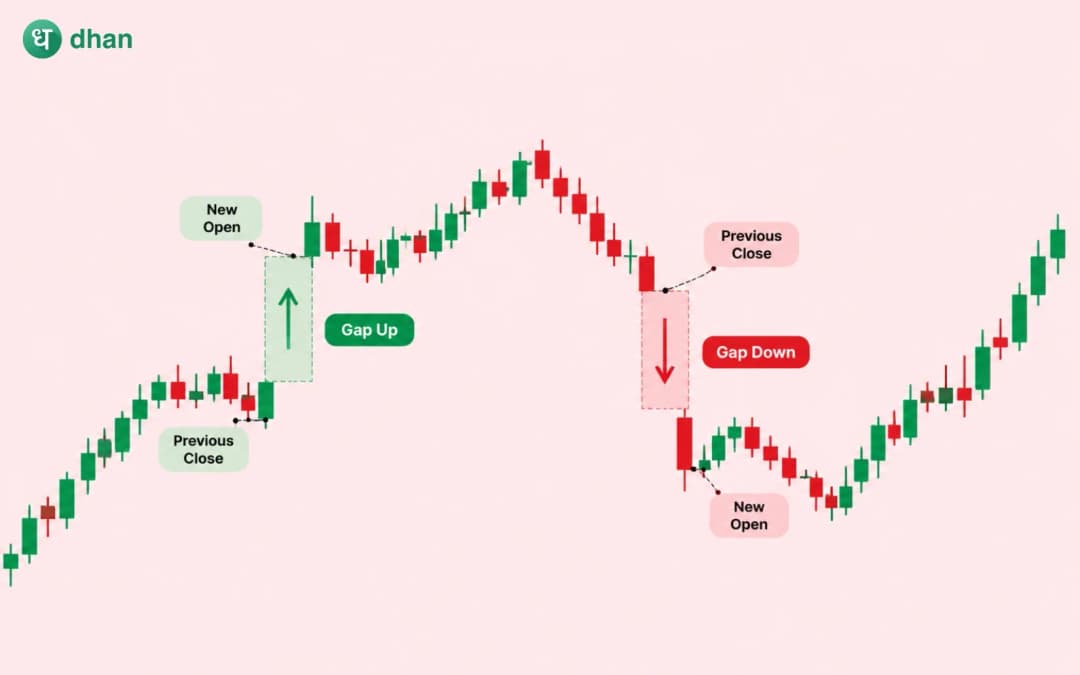
Suppose a stock closes at ₹500 on Monday, but when the market opens on Tuesday, it starts trading at ₹525. There were no trades between ₹500 and ₹525 during the opening transition. That ₹25 difference is a price gap.
Gaps are common in financial markets, particularly around market openings. They can appear after company announcements, earnings results, major economic developments, or sharp moves in overseas markets. Sometimes the gap continues in the same direction. At other times, the opening move quickly loses momentum, and the price moves back toward the previous closing level.
This is interesting for traders but also dangerous. If there is a big opening move, it can appear as if the market has already decided which way it wants to go, when the session may be played out much differently.
Gap trading involves studying these opening price differences and looking for a potential trading setup based on what happens after the gap. The objective is not simply to buy when the market gaps up or sell when it gaps down. Instead, traders generally examine the reason for the gap, its size, volume, market trend and subsequent price action before deciding whether a setup exists.
What is a Market Gap?
A market gap occurs when there is a recognisable difference between the opening price of an asset and its previous closing price.
For example:
- Previous close: ₹1,000
- Opening price: ₹1,040
- Gap: ₹40 or 4%
This is a gap up because the market opened above the previous close.
Conversely, if the asset closed at ₹1,000 and opened at ₹960, it created a gap down.
The gap itself is not necessarily a trading signal. Its significance depends on what caused it and how price behaves after the opening.
A gap can be identified when there is a visible space between the previous session's closing price and the current session's opening range. Smaller gaps may be seen frequently in the market, but a larger gap can attract more attention from traders.
Why do Market Gaps occur?
Gaps often occur because information or sentiment changes when the regular market is closed.
Some common causes include:
- Company-specific news: Earnings results, management announcements, mergers, regulatory developments or other corporate events can cause investors to reassess a stock.
- Global market movements: Indian markets, for example, can react to major overnight moves in US, European or Asian markets.
- Economic announcements: Interest-rate decisions, inflation data, employment data and other important economic releases can influence market expectations.
- Unexpected events: Geopolitical developments or other sudden events can produce a sharp change in market sentiment.
Changes in supply and demand: If buyers or sellers become significantly more aggressive between trading sessions, the next opening price can move away from the previous close.
Types of Market Gaps
Not every gap carries the same trading context. Traders commonly classify gaps according to where they appear in a price trend and what they may indicate.
Common gap
A common gap is usually a relatively small gap that occurs without a major change in the underlying trend. It can appear within a trading range or during normal market activity.
Breakaway gap
A breakaway gap occurs when price gaps away from an established trading range, consolidation zone or chart pattern.
Runaway gap
A runaway gap, also called a continuation gap, occurs during an established trend. It can indicate that participation in the existing trend is increasing.
Exhaustion gap
An exhaustion gap can appear late in a strong trend. Price gaps sharply in the direction of the existing move, but the momentum may subsequently weaken.
If you would like to read more and in-depth about gaps, you must read Types of Gaps in Trading
4 Best Gap Trading Strategies
There is no single way to trade a gap. The appropriate approach depends on whether the trader expects the gap to continue or reverse.
Gap-and-go Strategy
The gap-and-go approach looks for continuation after a strong opening gap.
Suppose a stock closes at ₹700 and opens at ₹735 after a significant positive announcement. Instead of immediately buying at the open, a trader may wait to see whether the price holds above important levels and whether buying activity continues.
You may follow the steps below:
- Identify a significant gap up.
- Check whether the gap is supported by strong volume or relevant news.
- Watch the first few candles for confirmation.
- Identify an entry after price demonstrates continued strength.
- Place a stop-loss at a predefined technical level.
- Exit based on the planned target or a change in price structure.
Gap-fill Strategy
A gap-fill strategy takes the opposite view. It looks for situations where price moves back toward the previous closing level.
For example, if a stock closes at ₹500 and opens at ₹530, but selling pressure quickly pushes it lower, a trader may monitor whether the price continues toward ₹500.
A gap fill does not necessarily happen because markets "must" fill gaps. That is an important distinction. A gap may remain open for a long time or become part of a larger trend.
Breakout Gap Strategy
A breakout gap can be traded when price moves beyond an established support or resistance zone.
Consider a stock that has spent several sessions between ₹1,200 and ₹1,250. It then opens at ₹1,270 and remains above ₹1,250.
Here, Rs 1,250 could prove to be an important support level. If price holds above it and buying volume is strong, traders will look for continuation setups. If price falls back below the prior resistance, the breakout may need to be reassessed.
Gap Reversal Strategy
A gap reversal setup develops when the opening move fails, and price starts moving in the opposite direction.
Suppose a stock gaps up sharply but cannot sustain the higher price. It then breaks below the low formed after the opening. A trader may interpret this as evidence that sellers are gaining control.
The setup becomes more meaningful when the reversal occurs around a known resistance zone or after an extended price move.
The main challenge is timing. Entering too early can mean trading against the initial momentum before a reversal has actually formed.
How to analyse a Gap before taking a trade
A gap should be viewed in context. A simple checklist can help traders avoid treating every opening jump as a signal.
- Measure the gap: Compare the opening price with the previous close. A larger gap can behave differently from a small opening difference.
- Identify the reason: Determine whether the gap is associated with company news, earnings, broader market movement or another catalyst.
- Check the trend: A gap occurring inside a strong trend may have different implications from one appearing after a prolonged sideways period.
- Mark support and resistance: Previous highs, lows, breakout levels and consolidation zones can provide useful reference points.
- Watch volume: Volume can help traders assess participation behind the opening move. A gap accompanied by increased activity may deserve closer attention.
- Observe the opening price action: Instead of predicting what happens next, watch whether price holds, extends or rejects the gap.
Advantages of Gap Trading
Gap trading offers the following advantages:
- The previous close and current open provide defined price levels that can help traders frame the setup and monitor whether the gap is holding or weakening.
- A gap that occurs beyond a well-defined trading range can help traders identify a potential shift from consolidation to directional movement.
- Gap setups can be studied alongside support, resistance, candlestick structures and volume, allowing traders to build a more structured trading plan.
Disadvantages of Gap Trading
Along with advantages, gap trading has the following limitations:
- Prices can move rapidly immediately after the market opens, making entries and exits difficult to execute at the expected levels.
- A stock may open strongly and then move sharply in the opposite direction. Traders who enter purely because of the opening gap can be caught on the wrong side.
- When a gap is caused by new information, the market may continue repricing the asset throughout the session, making historical technical levels less reliable.
Conclusion
Market gaps provide traders with useful information about changes in price and sentiment between trading sessions. However, the opening gap alone is rarely enough to form a complete trading setup.
Gap-and-go, gap-fill, breakout gap and gap reversal strategies approach these situations differently. Each requires traders to examine factors such as the size of the gap, market trend, support and resistance, volume and the reason behind the move.
FAQs
What is gap trading?
Gap trading is a trading approach that focuses on price gaps between an asset's previous closing price and its next opening price. Traders analyse whether the gap is likely to continue, reverse or become part of a broader price move.
Do all market gaps get filled?
No. A gap does not have to be filled. Some gaps can remain open while price continues in the direction of the original move.
Which indicators are useful for gap trading?
Volume, moving averages, VWAP, support and resistance levels, and price-action tools can be useful when analysing gaps. No single indicator confirms whether a gap will continue or reverse.
Is gap trading suitable for beginners?
Beginners can study gap trading, but they should understand that opening volatility can make these setups risky.
How is a gap calculated?
A gap can be calculated by comparing the current opening price with the previous session's closing price.