



How can you predict a Gap up or Gap down?





Key takeaways:
- A gap occurs when an asset opens noticeably below or above its previous closing price. It usually happens due to changes in investors' expectations as new information enters.
- It is impossible to predict the gap direction for any stock with complete certainty. It can be estimated, though, by observing the global market, overnight futures, announcements from companies, any news, and what the market looks like before it officially opens.
- The opening gap is only the starting point. Price action after the open, along with volume, support and resistance, and the size of the gap, helps determine whether the move may continue or reverse.
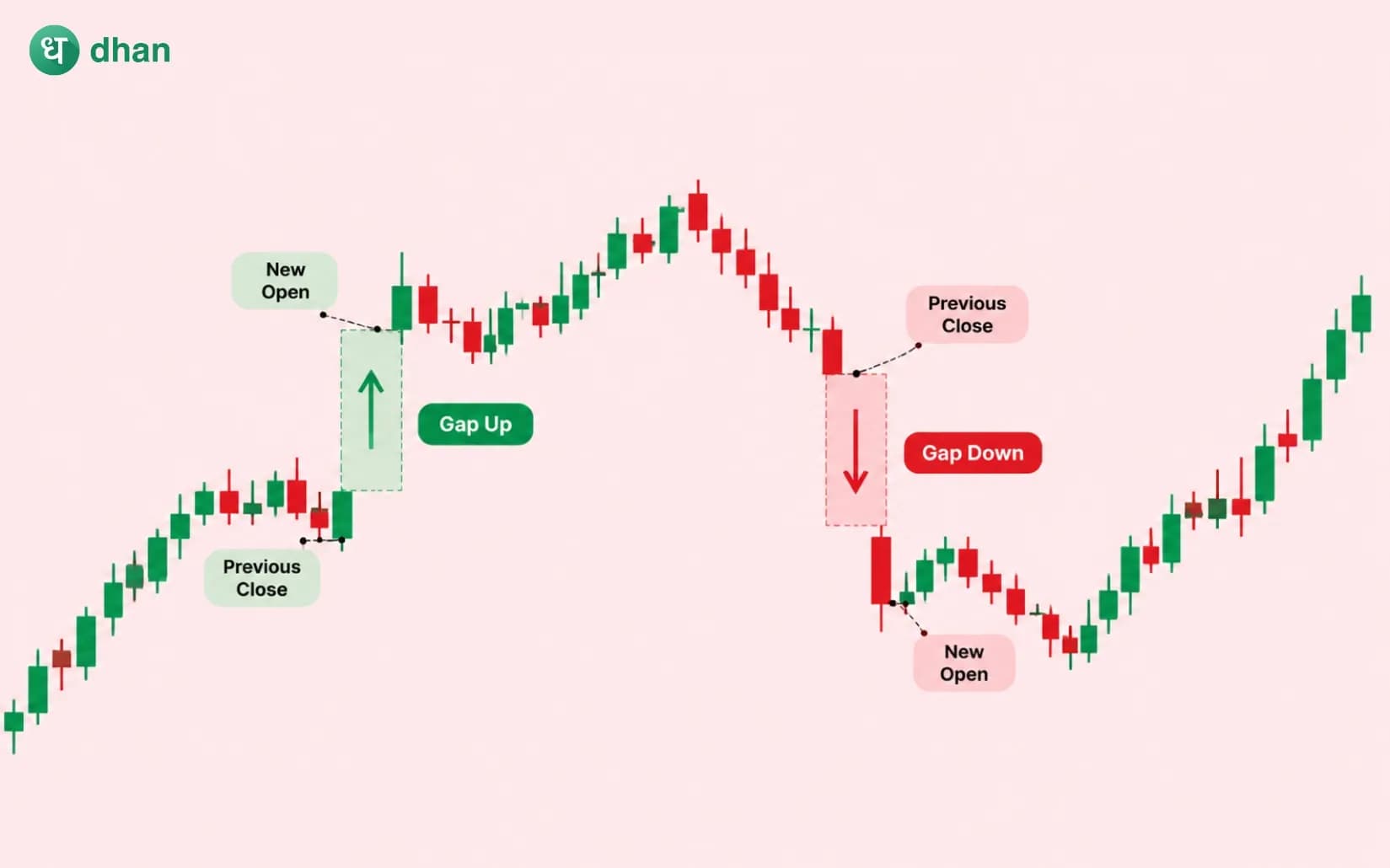
A trading session can sometimes begin at a price very different from where the previous session ended. If a stock closes at ₹1,000 and opens the next morning at ₹1,050, the ₹50 difference creates a gap up. If it instead opens at ₹950, the market has created a gap down.
Gaps are common in markets that trade across sessions because information can arrive when the regular market is closed. Company announcements, global market movements, economic data, geopolitical developments and changes in investor expectations can all influence the price at which trading resumes.
This raises an obvious question for traders: Can you predict whether the market will gap up or gap down? There is no method that can reliably predict every opening gap. However, traders can monitor several indicators and events before the market opens to assess whether conditions are pointing toward a potential gap.
What is a gap up and gap down?
A gap up forms when an asset opens above the previous session's high or at a price significantly above the previous close.
For example:
- Previous close: ₹1,000
- Previous high: ₹1,020
- Next opening price: ₹1,050
The stock has opened above the previous session's high, creating a gap up.
A gap down occurs when the asset opens below the previous session's low or significantly below the previous close.
For example:
- Previous close: ₹1,000
- Previous low: ₹980
- Next opening price: ₹950
The stock has opened below the previous session's low.
The size of the gap matters. A small difference between the previous close and the next opening may have a different significance from a large gap caused by a major overnight event.
Why do gaps occur?
Gaps are primarily caused by a change in the balance between buyers and sellers while the regular market is closed.
Suppose a company announces unexpectedly strong earnings after the market closes. Investors may revise their expectations and become willing to pay more for the stock.
When trading resumes, the stock may open substantially higher because there is a large difference between the prices buyers are willing to pay and the prices at which existing sellers are willing to transact.
The same process can occur in reverse. A negative announcement, weak earnings, regulatory development or adverse global event can cause selling pressure to build before the next session. The stock may then open significantly lower.
Can you predict a gap before the market opens?
You cannot know the exact opening price with certainty before the market opens. However, traders can look for pre-opening clues that may indicate whether a gap is possible.
The most important factors include:
- Overnight movement in global markets
- Index futures or other relevant pre-market indicators
- Major economic announcements
- Company-specific news
- Corporate actions and earnings announcements
- Currency and commodity movements
- Previous-session price structure
- Pre-market order imbalance or indicative opening data, where available
If an index closed at 22000 and relevant overnight indicators are trading with a significant up move, the traders might expect a gap up opening. However, the actual opening can vary because new orders and information can enter the market before the completion of the opening auction.
How global markets can signal a potential gap
For markets that trade during different time zones, overnight global markets can provide useful context. Suppose Indian markets closed yesterday with the Nifty at 22,000. Overnight, major global equity markets rise sharply, and relevant futures indicate higher prices.
This does not guarantee that the Nifty will have a gap up opening. However, it provides a reason to watch for a higher opening.
The same logic applies to a potential gap down. If global markets decline sharply overnight because of an important economic or geopolitical development, traders may expect weakness at the next domestic market open.
How index futures can help
For index traders, GIFT Nifty, which trades for most of day and night on NSE IX can provide another reference point.
Suppose an index closed at 22,000, while its relevant futures contract is trading around 22,250 before the next session.
The 250-point difference suggests that market expectations have shifted higher compared with the previous close.
If the relationship remains similar into the opening period, the index may open higher.
However, futures and cash prices can differ because of factors such as expiry, carrying costs, dividends and market conditions. Therefore, traders should not assume that the futures price will translate one-for-one into the exact cash-market opening price.
How news and events can create gaps
News is one of the most important sources of overnight gaps. For individual stocks, traders should pay attention to events such as:
- Quarterly earnings
- Major management announcements
- Mergers or acquisitions
- Regulatory decisions
- Large contracts or business developments
- Credit-rating changes
- Corporate actions
- Unexpected legal or operational developments
For broader indices, macroeconomic events can be important. Examples include:
- Central-bank decisions
- Inflation data
- Employment data
- Interest-rate announcements
- Government policy changes
- Major geopolitical developments
The closer the event is to the market opening, the more relevant it may be to the next session's opening price.
How the previous day's price action can help
The previous trading session can provide important technical context. Suppose a stock closed near its daily high after a strong upward move. If positive news arrives overnight, the stock may have conditions for another higher open.
On the other hand, if the stock closed near its low and negative news appears overnight, a gap down may become more plausible.
Previous support and resistance levels are also useful. For example, if a stock repeatedly struggles near ₹1,000 and then receives positive overnight news, traders can watch whether the stock opens above ₹1,000 and holds that level.
How to identify a potential gap up
A trader assessing the possibility of a gap up can work through a simple checklist. First, check whether the relevant global markets or futures are trading higher. Then look for positive overnight news affecting the stock, sector or broader market.
Finally, observe how the pre-market indication stacks up against the previous session’s close. Here is an example through which you may understand it better:
Suppose the previous close is ₹1,200 and overnight futures or related indicators are higher. Also, there is positive market sentiment because of a company announcement, and previous resistance is at ₹1,220.
Indicative opening is at ₹1,235. This setup suggests that traders should prepare for a potential gap above the ₹1,220 resistance area. But preparation is different from prediction. The actual opening can change before the market opens, and the stock may also reverse after the opening.
How to identify a potential gap down
Suppose a stock closed at ₹1,200. Overnight, the company releases negative news, and the relevant sector is also trading lower. If the pre-market indication points toward ₹1,150, the stock may be positioned for a gap down.
The trader can then identify nearby support levels and observe what happens after the opening. For example,
- Previous close: ₹1,200
- Negative company announcement: yes
- Sector movement: lower
- Indicative opening: ₹1,150
- Previous support: ₹1,140
The stock could open near ₹1,150 and either continue lower or recover toward the previous support area.
What happens after a gap?
A gap can lead to several different outcomes. Some of them are:
Gap continuation
The price opens higher and continues moving in the same direction. For example, a stock closes at ₹1,000, opens at ₹1,050 and continues toward ₹1,100. This type of movement indicates that buying pressure remains after the opening.
Gap fill
A gap fill occurs when price moves back toward the area created by the opening gap. Suppose a stock closes at ₹1,000 and opens at ₹1,050. If it subsequently falls toward ₹1,000, traders may describe the gap as being filled. A gap fill is not guaranteed. Traders should avoid assuming that every gap will eventually close.
Gap reversal
Sometimes the market opens strongly in one direction but then reverses. For example, a stock may gap up 5% but face selling pressure soon after the opening and fall below the opening price. This is why the first few minutes of price action can be important when analysing a gap.
How volume helps analyse a gap
Volume can provide additional context after the market opens. For example, suppose a stock gaps up and continues higher with strong trading activity. It shows that the opening move is accompanied by substantial participation.
Now consider a stock that gaps up but quickly loses momentum while trading activity increases on the decline. The second situation deserves a different interpretation because sellers are becoming active after the gap.
How support and resistance can be used after a gap
Support and resistance levels can help traders structure their analysis after the opening. Suppose a stock closes at ₹1,000 and opens at ₹1,060, above a resistance level at ₹1,040.
The trader can observe whether ₹1,040 now acts as support. If the price falls below that level soon after opening, the gap-up move may be losing strength.
Similarly, after a gap down below a support level, traders can observe whether the broken level becomes resistance when the price attempts to recover.
Conclusion
Predicting gap up and gap down is less about finding a single indicator and more about assessing the information available before the market opens. Global market movements, futures, overnight news, corporate announcements, economic events and previous price levels can all provide clues about the potential opening direction.
However, none of these factors can guarantee the exact opening price or what will happen afterwards. The more practical approach is to prepare for different gap-trading scenarios. Identify the potential gap, mark important support and resistance levels, and then observe how price behaves after the market opens.
FAQs
1. Can gap ups and gap downs be predicted accurately?
They cannot be predicted with certainty. Traders can use overnight markets, futures, news, pre-market indications and previous price action to assess the possibility of a gap.
2. Which factors can indicate a possible gap up?
Higher overnight global markets, positive company news, favourable economic developments and higher relevant futures or pre-market indications can point toward a potential gap up.
3. Which factors can indicate a possible gap down?
Weak global markets, negative company news, adverse economic developments and lower relevant futures or pre-market indications can point toward a potential gap down.
4. What is a gap fill?
A gap fill occurs when price moves back into the area created by the opening gap. For example, if a stock closes at ₹1,000 and opens at ₹1,050, a later move back toward ₹1,000 would be considered a gap fill.
5. What is a gap reversal?
A gap reversal occurs when an asset opens significantly higher or lower but then moves in the opposite direction.