



Range Trading Strategy






Key takeaways
- Range trading is a type of trading strategy in which an asset’s price moves between defined areas of support and resistance.
- Range traders use this strategy for opportunities to buy at the support level and sell at the resistance level.
- Range trading is effective in sideways or consolidating markets, but can be challenging during strong trends.
- Stop-losses and suitable position sizing are important because breakouts can easily make a range invalid.
- Entries are better supported by price action or other confirmation signals, rather than relying solely on a price level.
At times, a price chart tells a simple story: buyers are active below, sellers are active above, and neither side is able to dominate the market for long. If such patterns continue to form, the market could be creating a trading range. Traders can use this range as a basis to spot potential entry and exit points, rather than trying to catch every price action. The challenge, however, is to identify solid trading ranges and manage them properly as soon as the market starts to ignore them.
In this article, we will explain what range trading is, how to identify a trading range, important entry and exit points and effective risk management strategies for dealing with such ranges.
What is a Range Trading Strategy?
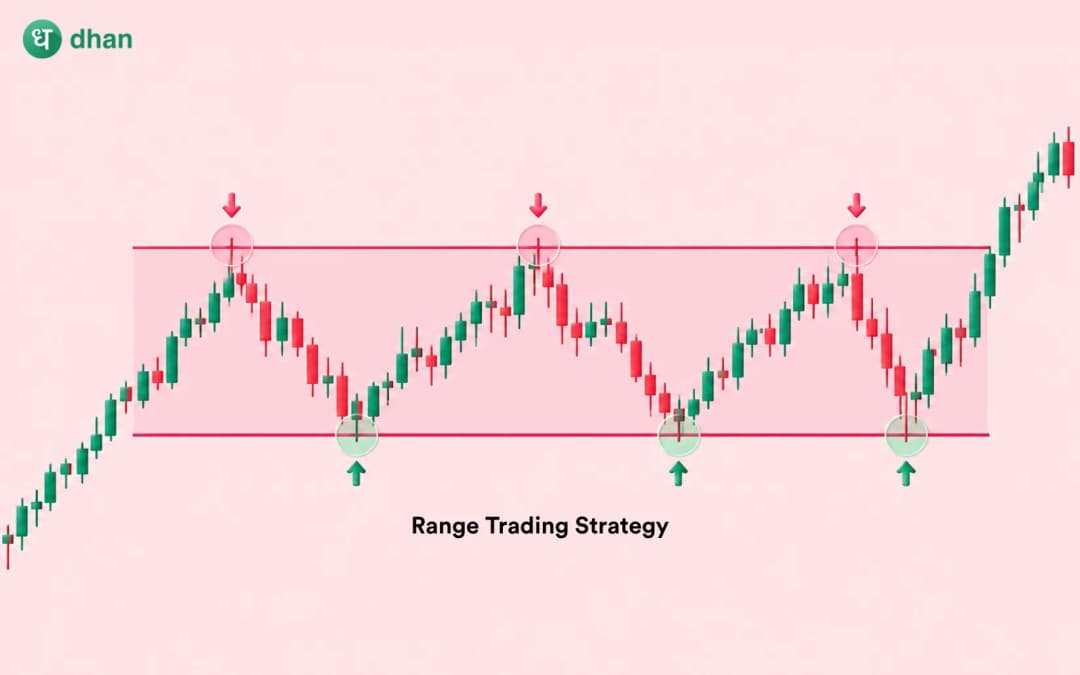
The range trading strategy involves identifying market conditions where prices trade within well-defined support and resistance levels. Traders look to buy near the lower boundary and sell near the upper boundary in anticipation of potential reversals at these levels. By focusing on short-term changes, range trading enables traders to profit from historical patterns formed by market behaviour.
However, traders must remember that range trading works best in sideways or consolidating market conditions, where price trends are limited.
How to identify a Trading Range
Finding a trading range demands much more than identifying a sideways price movement. Traders need to confirm that prices consistently respect clear support and resistance levels and the range offers sufficient space for a worthwhile trade.
Look for confirmed support and resistance
A reliable range must have at least two significant price movements around both support and resistance areas. The more consistent the price reversals from these boundaries, the stronger the range. Four to five clear tests provide better evidence of a market response than just one touch.
Check the range width
There must be adequate space between support and resistance levels to accommodate entries, stop losses and profit targets. Narrow ranges may fail to provide adequate trading opportunities after accounting for spreads, slippage and transaction costs.
Generally, traders aim for a 1.5:1 risk-reward ratio, meaning that the potential gain should exceed 1.5 times the amount at risk. If the range size does not support such a risk-reward ratio, then the trading opportunity may not be worth pursuing.
Use ADX for confirmation
The Average Directional Index can be used to identify whether a market is trending or moving sideways. A value below 25 indicates a weak and possibly non-trending market, whereas a value above 25 indicates increasing trend strength. If the ADX line begins to rise strongly, traders should be cautious as it indicates that the market is moving out of its trading range.
Range Trading entry rules
Range trading entries begin with identifying clear areas of support and resistance. Traders should wait for prices to reach one of these levels, rather than trying to trade at the middle of a range.
Buy near support
When the price reaches the support level, traders look for signs that selling pressure is starting to weaken. A rejection candle, bullish price action, or a failure to make a new low indicates that buyers are beginning to gain control. The entry is usually taken after this confirmation rather than at the first support touch.
Sell or short near resistance
If the price reaches a resistance level, traders seek signs of weakening buying momentum. If the price cannot break above the resistance zone and starts to decline, this can create a short selling opportunity. Resistance can be used as the stop-loss area, while support can be the target.
Wait for confirmation
Do not trade just because the price reaches support or resistance level. Wait for indications that the price level is holding as support. Confirmation can come from price action, volume, or indicators such as the Relative Strength Index.
Check risk and reward
Before entering any trading position, make sure the potential gains justify the potential losses. For example, if you risk ₹10 per share to earn ₹30, then the potential gain should be three times higher than the associated risk.
Avoid chasing price
If the market price has moved away from your planned entry point, avoid entering the trade. It is better to wait for a new opportunity.
Range Trading exit rules
A range trading exit plan should be established before entering the trade. The goal is to secure some profits when the price approaches the opposite side of the range or to limit losses if the range is broken.
Exit near the opposite boundary
In range trading, most traders exit long positions as the price nears resistance. Similarly, a short position is closed when the price heads towards support. Exiting before these levels can help manage risk since prices do not always hit the exact boundary.
Set a stop loss beyond the range
A stop loss limits potential losses if the price breaks out of a range. For long positions, stop losses are set below the key support level, while for short positions they are set above the resistance level. The stop loss should be set far away to allow for normal price fluctuations, while the position size should be adjusted according to the risk.
Exit when the range breaks
No range can hold forever; eventually, it breaks. If the price breaks above resistance or below support levels, the initial trading opportunity may be invalid. Rather than holding onto a losing position in the hope that the price will come back to the range, it's better to cut your losses and exit according to your strategy.
Take partial profits
Traders can close a portion of their positions as prices move towards the target, and keep the remaining portion open. This way they will secure some profit while still benefiting if the price continues towards the opposite boundary.
Avoid moving the stop-loss
Moving a stop-loss away from you as the trade moves against you can lead to increased potential losses. Traders should determine their maximum tolerable risk before entering the trade and maintain it throughout the trade.
Keep the exit plan simple
To create a simple exit plan, set a stop loss order before entering the trade, identify the opposite side of the trading range and exit the trade if the trading range breaks. Good risk management allows you to profit from price movements within the trading range.
Risk management for Range Trading
Proper risk management helps traders keep potential losses under control and safeguard their capital while trading within a particular range.
- Keep risk under control: Never engage in any trading activity without placing a stop loss order. If the breakout turns out to be false, a stop loss order can help limit the financial losses.
- Position sizing: Manage trade size according to your risk tolerance and portfolio exposure. Controlling position sizes helps ensure that no single trade significantly affects overall capital.
- Prepare for range breakouts: All ranges can eventually lead to breakouts. Prepare an exit strategy in advance so that you are prepared if prices make a strong move above resistance or below support levels.
- Look for an appropriate risk-reward ratio: To determine whether it is worth taking the risk, compare the potential profit with the amount at risk. Enter trades only when the potential reward justifies the risk.
- Avoid excessive leverage: High leverage increases both possible gains and losses. Maintain appropriate exposure to deal with any unexpected changes in market prices.
Indicators that can support Range Trading
The technical indicators listed below enable traders to identify changes in market momentum, volatility and possible reversal points within a given range.
- Bollinger Bands: Bollinger Bands allow traders to monitor market volatility and identify whether prices are moving towards the upper or lower ends of their recent trends.
- Volume: Volume provides information about the strength behind any price movement. An increase in volume during a breakout suggests that there is strong market participation that could lead to changes in market conditions.
- Stochastic Oscillator: The Stochastic Oscillator provides information on market momentum and identifies possible reversal points at support and resistance levels. The stochastic oscillator is useful during sideways moves in the market.
- Relative Strength Index: The RSI is used to identify overbought and oversold conditions close to the boundaries of the price range. An extreme reading may support a reversal setup, but it should not be used on its own as an entry signal.
Common Range Trading mistakes
Some common mistakes made by traders using a range trading strategy can reduce success rates and increase financial losses.
- Trading every touch: A price touching support or resistance does not necessarily indicate a reversal. Wait for further signals to confirm any potential breakouts or breakdowns rather than expecting the level to hold.
- Start trade in the mid-range: Trading in the middle of a range gives relatively poor risk-reward ratio opportunities. Good trading opportunities arise near strong boundaries of support and resistance areas.
- Not respecting a breakout: Continuously trading against a confirmed breakout can lead to big losses. Specify a level that signals whether a range trading setup is valid or not.
- Placing a stop too close: A stop placed directly at a support or resistance level can be hit by normal market movements. Consider volatility when deciding on the optimal stop-loss distance.
- Trading very tight ranges: Extremely small ranges will not give you enough possible profit after considering trading costs and risk. Look for ranges with sufficient price movements as per your trading goals.
Conclusion
Range trading can be an effective strategy when an asset is constantly moving between clear support and resistance levels. It enables traders to focus on specific price ranges rather than trying to identify all market movements. However, discipline plays a crucial role in executing this strategy effectively.
Traders are advised to wait for favourable opportunities, handle their trades cautiously, set predetermined exit levels and be ready for a breakout. The goal is not to win all trades, but to limit losses and follow a consistent process while trading within a defined range.
FAQs
What is the best indicator for range trading?
No single indicator is perfect for range trading. The RSI, Stochastic oscillator, Bollinger bands and volume indicators can provide additional confirmation. However, support and resistance should be the main focus. Use indicators to strengthen your analysis, but do not replace them with your overall analysis.
How do I know when a range has failed?
Moving decisively below support or above resistance levels indicates that a range has failed. Strong momentum or high trading volume can provide more confirmation.
Can I use range trading for intraday trading?
Yes. Range trading can be applied for both intraday and swing trading. However, shorter time frames can produce more market noise and false signals.
Where should I put a stop-loss in range trading?
Place the stop loss beyond the significant support or resistance level. Consider an asset’s volatility level and maximum acceptable loss when deciding the distance of the stop loss.
Is range trading profitable?
Range trading can be profitable when the market conditions are right for the strategy, and all trades are managed consistently. However, false breakouts can result in losses, and there is no guarantee of profits.