



Gamma Scalping Strategy







Key takeaways
- Gamma scalping is an options trading approach that involves actively adjusting a delta-hedged options position as the underlying asset moves.
- Gamma measures how quickly an option's delta changes when the underlying price changes. Higher gamma means delta can change more rapidly.
- Traders generally use gamma scalping with long gamma positions, often created by buying options, while using the underlying asset to manage directional exposure.
- The strategy aims to benefit from repeated price movements in the underlying rather than simply predicting whether the market will finish higher or lower.
- Transaction costs, bid-ask spreads, time decay and implied volatility can significantly affect the outcome of a gamma scalping strategy.
- Gamma scalping requires frequent monitoring and disciplined position management, making it considerably more complex than simply buying or selling an option.
Options can change in value for several reasons. The underlying asset may move, volatility may change, or time may pass. For traders who actively manage these effects, the Greeks provide a way to understand how an options position responds to different market conditions.
One of these Greeks is gamma. It measures how much an option's delta changes when the underlying asset moves. A trader holding a position with positive gamma can see the position's delta change as the market moves, creating opportunities to repeatedly adjust the hedge.
This is the basic idea behind gamma scalping.
Instead of relying entirely on a directional prediction, the trader attempts to manage the changing delta of an options position by buying or selling the underlying asset. The process can involve multiple adjustments during the life of the trade.
What is Gamma in option trading?
Before understanding gamma scalping, it helps to understand delta.
Delta measures how much an option's price is expected to change for a one-unit change in the underlying, all else being equal. A call option has positive delta, while a put option has negative delta.
Gamma measures the rate of change of delta.
For example, imagine an option has a delta of 0.50. If the underlying moves higher and the option's delta changes from 0.50 to 0.55, gamma describes the sensitivity behind that change.
This matters because delta is not fixed. As the underlying price changes, an option's delta can change too. Gamma tells the trader how quickly that adjustment can happen.
You might want to read this: All Option Greeks Explained
What is Gamma Scalping?
Gamma scalping is a strategy in which a trader typically holds a positive gamma options position and uses the underlying asset to adjust the position's delta.
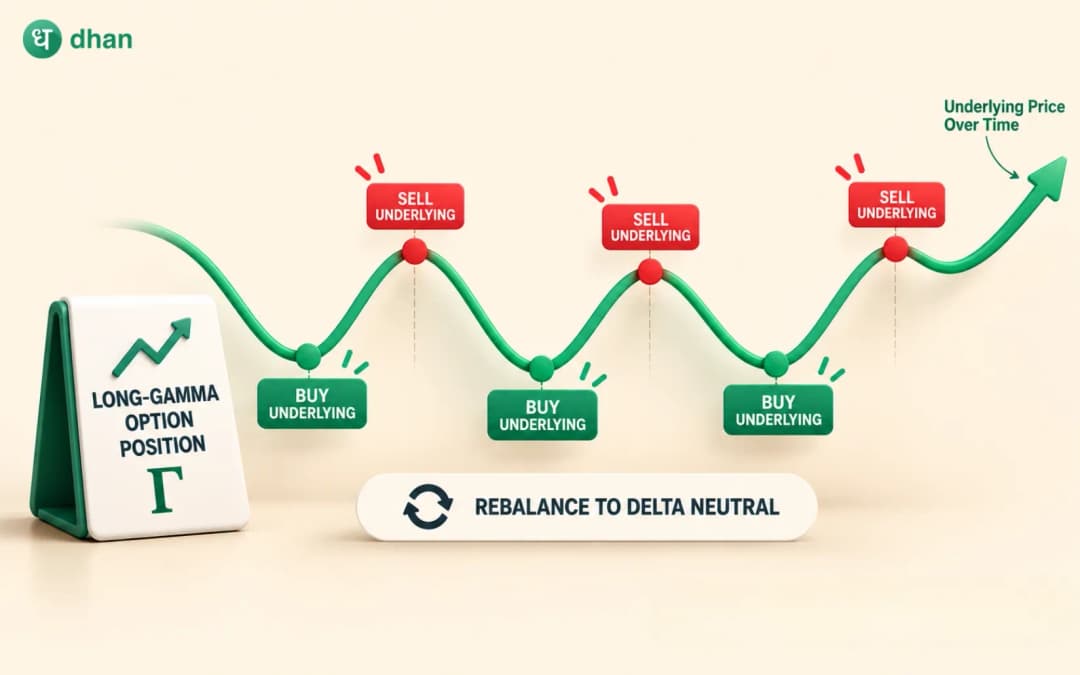
The trader may initially hedge the options position so that its overall delta is close to neutral. As the underlying moves, gamma causes the options position's delta to change. The trader then buys or sells the underlying to bring the overall position back toward the desired delta.
This can lead to a pattern of buying the underlying after it falls and selling it after it rises when managing a long-gamma, delta-neutral position.
For example, consider a simplified long-gamma position that is initially delta-neutral. If the underlying rises, the options position may develop positive delta. The trader can sell some of the underlying to reduce that exposure.
If the underlying subsequently falls, the options position's delta can move in the opposite direction. The trader may then buy the underlying to rebalance.
This repeated hedging is the scalping part of gamma scalping.
How Gamma Scalping works?
The strategy can be understood through a sequence of steps.
Establish a positive Gamma position
The trader takes an options position with positive gamma. Long options generally have positive gamma, although the exact position structure determines the overall gamma of the portfolio.
The trader also considers the option's expiry, strike, implied volatility and premium before establishing the position.
Hedge the Delta
The options position is then hedged using the underlying asset or an appropriate related instrument.
The objective is usually to reduce directional exposure rather than to eliminate all possible risk. A delta-neutral position can still be affected by volatility, time decay, gamma and execution costs.
Allow the underlying to move
As the underlying price changes, gamma causes the option position's delta to change.
For a positive-gamma position, the delta tends to increase when the underlying rises and decrease when the underlying falls.
Rebalance the hedge
When the position's delta moves away from the trader's desired level, the underlying position is adjusted.
If the underlying rises and the options position becomes more positively exposed, the trader may sell some underlying. If the underlying falls and the options position becomes more negatively exposed, the trader may buy some underlying.
Practical Example of Gamma Scalping
Suppose a trader holds a long options position with positive gamma and initially hedges it to approximately zero delta.
Assume that the underlying is trading at ₹1,000.
The underlying then rises to ₹1,020. As the position has positive gamma, its delta becomes more positive. The trader sells some units of the underlying to reduce the resulting directional exposure.
Later, the underlying falls from ₹1,020 to ₹990. The options position's delta changes again, this time in the opposite direction. The trader buys some of the underlying to rebalance.
The trader has therefore adjusted the hedge after the upward move and again after the downward move.
Why price movement matters
Gamma scalping is particularly sensitive to the path taken by the underlying. Imagine two trading sessions where an underlying begins at ₹1,000 and ends at ₹1,000.
In the first scenario, the price barely moves throughout the session. There may be little opportunity for meaningful hedge adjustments.
In the second scenario, the price moves from ₹1,000 to ₹1,050, falls to ₹980 and eventually returns to ₹1,000. A positive-gamma trader may have made several hedge adjustments during those movements.
The final price is identical in both cases, but the trading path is very different.
Gamma Scalping and Theta Decay
One of the most important trade-offs is the relationship between gamma and theta.
Theta represents the sensitivity of an option's price to the passage of time. For an option buyer, time decay generally works against the position, all else being equal.
A long-gamma position therefore typically carries a time-decay cost. Gamma scalping attempts to generate gains from active hedging that can offset some or all of this cost.
The underlying needs to move sufficiently, and the trader needs to execute the hedges effectively, for the strategy to make economic sense.
Gamma Scalping and Implied Volatility
Implied volatility (IV) reflects the market's pricing of expected future volatility and is an important component of an option's premium.
A gamma scalping position can be affected by changes in implied volatility even if the underlying does not move much. When a trader buys options, the premium paid reflects the market's volatility expectations at that time.
This creates an important consideration: a trader may successfully execute several hedge adjustments and still face losses if other components of the position work against them.
When can Gamma Scalping be considered?
Gamma scalping is generally associated with situations where the trader expects sufficient movement in the underlying to justify the cost of holding the options and repeatedly adjusting the hedge.
For example, a trader may consider a long-gamma position when expecting the underlying to experience meaningful realised volatility.
However, the strategy does not require the trader to correctly predict the final direction of the market. The focus is on managing the changing delta and capturing gains from price movements through the hedge.
That does not make the strategy direction-neutral in every practical sense. The options' implied volatility, time decay and transaction costs still influence the economics.
Advantages of Gamma Scalping Strategy
The advantages of gamma scalping are as follows:
- A long-gamma position can create changing delta as the underlying moves, giving the trader opportunities to adjust the hedge after price fluctuations.
- By continuously managing delta, the trader can keep the overall position closer to a chosen exposure level.
- The hedge adjustments are linked to changes in the option position's delta. This makes gamma a functional part of the trading process.
- When an underlying experiences repeated movements, a positive-gamma position can require multiple hedge adjustments. Those movements can create opportunities to realise gains through the hedge.
Disadvantages of Gamma Scalping Strategy
Along with advantages, the gamma scalping strategy has the following limitations:
- Repeated buying and selling can generate brokerage, exchange charges, bid-ask spread costs and market-impact costs.
- Long-gamma positions generally involve buying options, which means time decay can reduce the option's value as expiry approaches.
- A position may have substantial gamma but still lose money if the realised movement is insufficient relative to the option premium and other costs.
- Delta changes as the underlying moves, so the hedge may need to be adjusted repeatedly.
Conclusion
Gamma scalping is a dynamic options strategy based on positive gamma and active delta management. As the underlying moves, the option position will change in delta and the trader will adjust the underlying hedge to manage that exposure.
The strategy can create opportunities from repeated price movements, but those opportunities come with costs. Theta decay, implied volatility, bid-ask spreads, brokerage and frequent execution can materially affect the result.
FAQs
What is gamma scalping in simple terms?
Gamma scalping is the activity of holding a positive gamma options position and constantly re-hedging into the underlying as the delta of the options changes. The trader attempts to profit from price movements while controlling directional exposure..
Is gamma scalping profitable?
Gamma scalping is generally more complex than straightforward option buying because it requires an understanding of the Greeks and active hedge management.
Can gamma scalping be done with calls and puts?
Yes. Gamma is generally positive for long calls and long puts. The overall gamma of a strategy depends on the complete options position.
What is the role of theta in gamma scalping?
Theta represents the effect of time passing on an option's value. For long options, time decay generally creates a cost, so the gains from hedge adjustments need to be considered against this decay.
What should traders monitor while gamma scalping?
Traders generally need to monitor the underlying price, option delta, gamma, theta, implied volatility and the current hedge.