

 Nifty 50
 Sensex
 US Tech 100
 Dow Jones
 FTSE
 Dax
 CAC
 Nikkei 225
 Hang Seng
 SSE Composite
 TAIEX
 KOSPI
 Gift Nifty
 Strategy Indices
 Broad Market Indices
 Sectoral Indices
 Thematic Indices

Home
Finance GlossaryForeign Direct Investment
Foreign Direct Investment
Definition of Foreign Direct Investment
Foreign Direct Investment (FDI) is the act of acquiring a majority stake in a company located in a different country with the intention of assisting, growing, and managing the business.
FDIs and FPIs may seem similar but there is a major difference - lasting interest. When a company or investor obtains at least 10% control of foreign company with the intention of actively managing the business, it’s known as lasting interest.
A company that establishes a subsidiary in another country can also be classified as FDI. FDIs can also be made through mergers and acquisitions as well as collaborations with foreign companies
Related Terms
Settlement Cycle
The settlement cycle refers to the time taken to complete a trade once it is executed. Equities in India have T+1 days for settlement. This indicates the shares and funds are exchanged only one business day after the trade is executed. A shorter settlement cycle reduces counterparty risk. It also ensures that investors get faster access to their money or securities.
Beta Coefficient
Beta coefficient is used to measure the volatility of stocks in relation to changes in the market. Basically, Beta helps investors understand the risks associated with a stock compared to the market.
The formula to calculate the Beta coefficient is:
Beta (β) = Covariance (Ri, Rm) / Variance (Rm)
Where:
The formula to calculate the Beta coefficient is:
Beta (β) = Covariance (Ri, Rm) / Variance (Rm)
Where:
- Ri = a stock's return
- Rm = overall market's return
- Covariance = ups & downs of stock returns versus ups & downs of market returns
- Variance = the difference between market returns and its average
Generally, Beta values are of four types:
- Beta < 1.0: stock less volatile than the market
- Beta = 1.0: stock just as volatile as the market
- Beta > 1.0: stock more volatile than the market
- Negative Beta: stock shares inverse relation with the market
Cash Ratio
A cash ratio measures a company’s ability to fulfill short-term debt obligations using only its cash and cash equivalents, which are known to have high liquidity. The formula for calculating cash ratio is:
Cash Ratio: Cash + Cash Equivalents / Current Liabilities
Cash Ratio: Cash + Cash Equivalents / Current Liabilities
Pennant Pattern
A Pennant is a continuation chart pattern used in technical analysis, and is shaped like a small, symmetrical triangle or a flag. It is formed following a sharp, significant move in price (either up or down) and represents a brief consolidation phase where volume is declining. The pennant pattern is characterised by two converging trend lines. Once the consolidation is over, a breakout from the pennant pattern (in the direction of the initial move) is anticipated, which indicates a continuation of the previous trend. Traders look for a large volume to accompany the breakout to confirm the move.
Derivatives Market
The derivatives market is a place where financial contracts like futures, options, forwards, and swaps are traded. It is a complex market that is a subset of the stock market, commodity market, currency market, and others depending on the underlying asset that’s a part of the derivative contract.
Iceberg Order
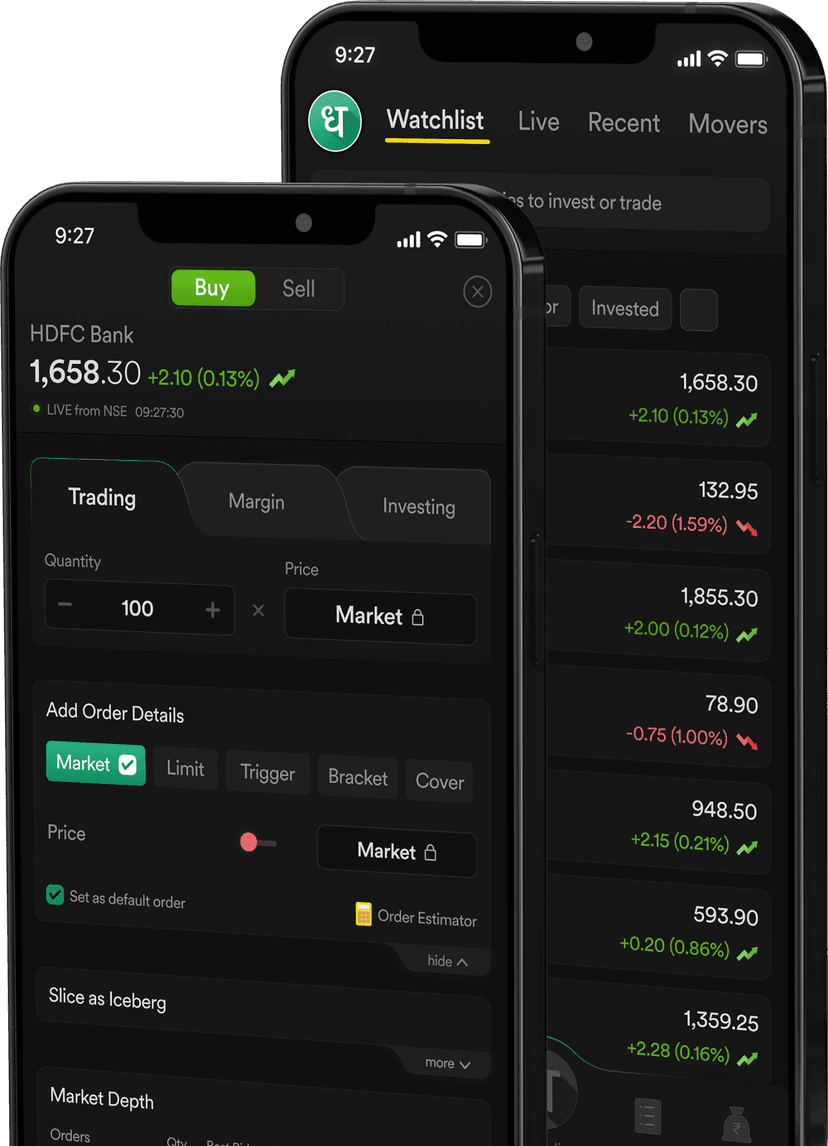
An Iceberg Order is used to slice and execute large orders into multiple “legs”. Large orders have the potential to drastically affect stock prices and subsequently investor behaviour.
That’s why institutional investors or traders with a relatively large buy or sell order place an Iceberg Order, thus masking their total transaction value and effectively going under the radar.
Brokers and trading platforms offer Iceberg Orders as a feature, which is activated after a certain quantity of scrips or contracts are selected, typically above 100.
Invest & Trade with a Trading
Platform That's #MadeForTrade
Open your Dhan Account in minutes!