

 Nifty 50
 Sensex
 US Tech 100
 Dow Jones
 FTSE
 Dax
 CAC
 Nikkei 225
 Hang Seng
 SSE Composite
 TAIEX
 KOSPI
 Gift Nifty
 Strategy Indices
 Broad Market Indices
 Sectoral Indices
 Thematic Indices

Home
Finance GlossaryWorking Capital
Working Capital
Definition of Working Capital
Working capital represents a company’s short-term financial health and operational efficiency, calculated as current assets minus current liabilities. For instance, a business with sufficient working capital can comfortably pay suppliers and meet day-to-day expenses, while negative working capital may indicate liquidity challenges.
Related Terms
52 Week High
A 52-week high is the highest closing price of a stock or ETF in the last 365 days. Say for example you’re checking the history of a stock on 01-01-2022. Then its 52 week high will be the highest price it closed at between 01-01-2021 and 01-01-2022. 52 week highs are used as technical indicators by traders.
Ex-Dividend Date
The ex-dividend date is the trading day on and after which a new buyer of the stock is not entitled to any dividends. Most traders say that a stock has gone ex-dividend when this happens.
Traditionally, the ex-dividend date is set a day before the record date when a company evaluates its records for existing shareholders. If a trader buys a stock that has gone ex-dividend from a seller, the one who'll get dividends is the seller.
Traditionally, the ex-dividend date is set a day before the record date when a company evaluates its records for existing shareholders. If a trader buys a stock that has gone ex-dividend from a seller, the one who'll get dividends is the seller.
Iceberg Order
An Iceberg Order is used to slice and execute large orders into multiple “legs”. Large orders have the potential to drastically affect stock prices and subsequently investor behaviour.
That’s why institutional investors or traders with a relatively large buy or sell order place an Iceberg Order, thus masking their total transaction value and effectively going under the radar.
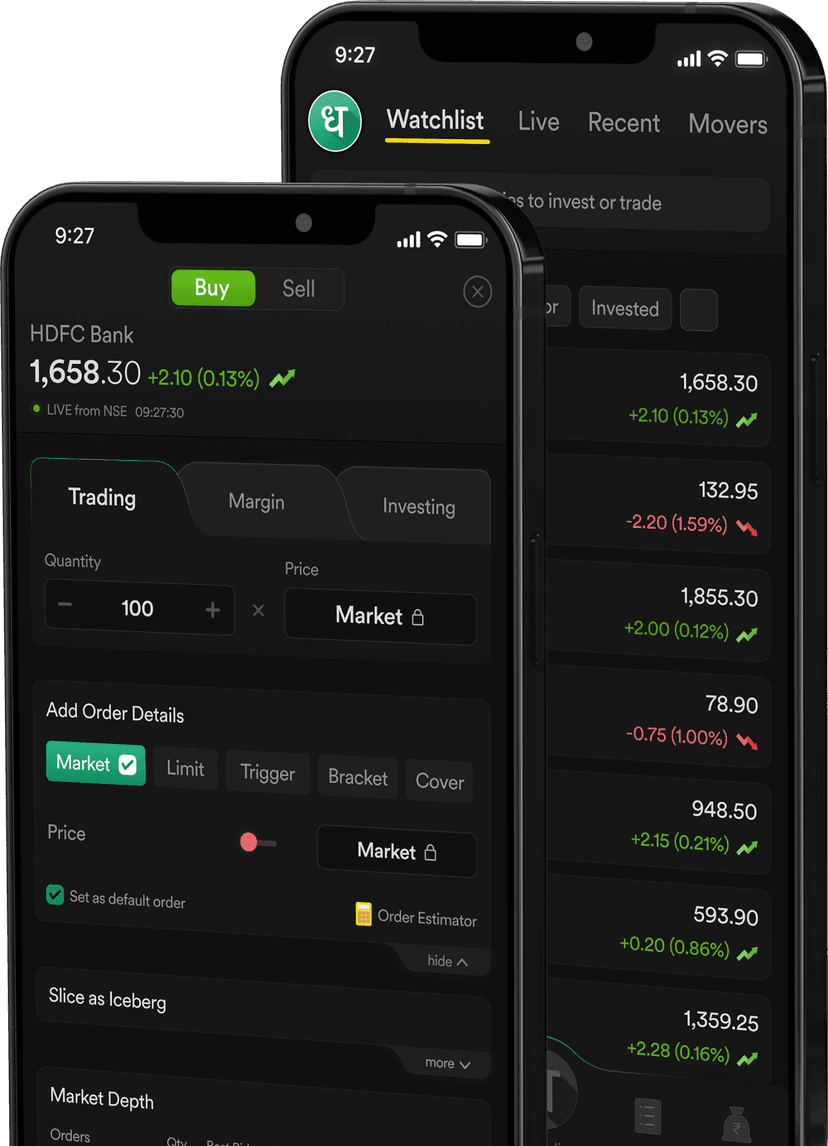
Brokers and trading platforms offer Iceberg Orders as a feature, which is activated after a certain quantity of scrips or contracts are selected, typically above 100.
Face Value
The term face value refers to the actual price of a stock that’s obtained by dividing a company’s net value by its total shares outstanding. In India, the face value of shares can range from Rs. 1 to Rs. 100.
However, the market value of the share may vary. At times, the difference can be drastic. For example, the face value of an MRF share is Rs. 10 but the market value (LTP) of the same share is Rs. 86,313.45.
Face value is also known as nominal value or par value. The latter is used frequently in the case of bonds.
The face value of a bond is the amount that an investor receives from the issuer on maturity. Similar to stocks, bonds and other fixed income instruments may have a different face value and market value.
Book Building
Book building is the process of determining the potential issue price of a financial instrument based on investor demand, generally during an IPO.
Book building is typically done by an underwriter (like an investment bank) who will invite institutional investors like hedge funds, mutual funds, and others to submit bids for the financial instrument.
These bids act as a range that the underwriter can use to fix a price that satisfies the company issuing the security and market participants.
Mean Absolute Deviation
Mean Absolute Deviation (MAD) is a statistical measure that shows how much the values in a data set differ from the average. It is calculated by taking the average of the absolute differences between each value and the mean.
Invest & Trade with a Trading
Platform That's #MadeForTrade
Open your Dhan Account in minutes!